An Art Deco library is made to do more than hold books. Its tower, entrance, lettering, doors, figures, and interior ornament can turn the approach to knowledge into a public experience. The most rewarding examples make their purpose visible before a visitor opens a book.
Begin with the building’s public face
A library’s exterior often tells you what kind of attention it expects.
Read More
Before looking for a zigzag or sunburst, step back far enough to see the whole composition. Does a tower act as a landmark? Does a broad wall feel calm and monumental? Does the entrance gather the eye through a stair, arch, sculpted surround, or line of lettering? Art Deco libraries often rely on that sequence: a clear form from a distance, then richer evidence at the threshold.
This is why an Art Deco library can feel both modern and ceremonial. The building may use simplified massing and confident geometry, yet it makes time for sculpture, mosaic, bronze, stone, and inscriptions. Those choices are not spare decoration added after the fact. They establish the library as a civic place, built for shared memory as well as quiet study.
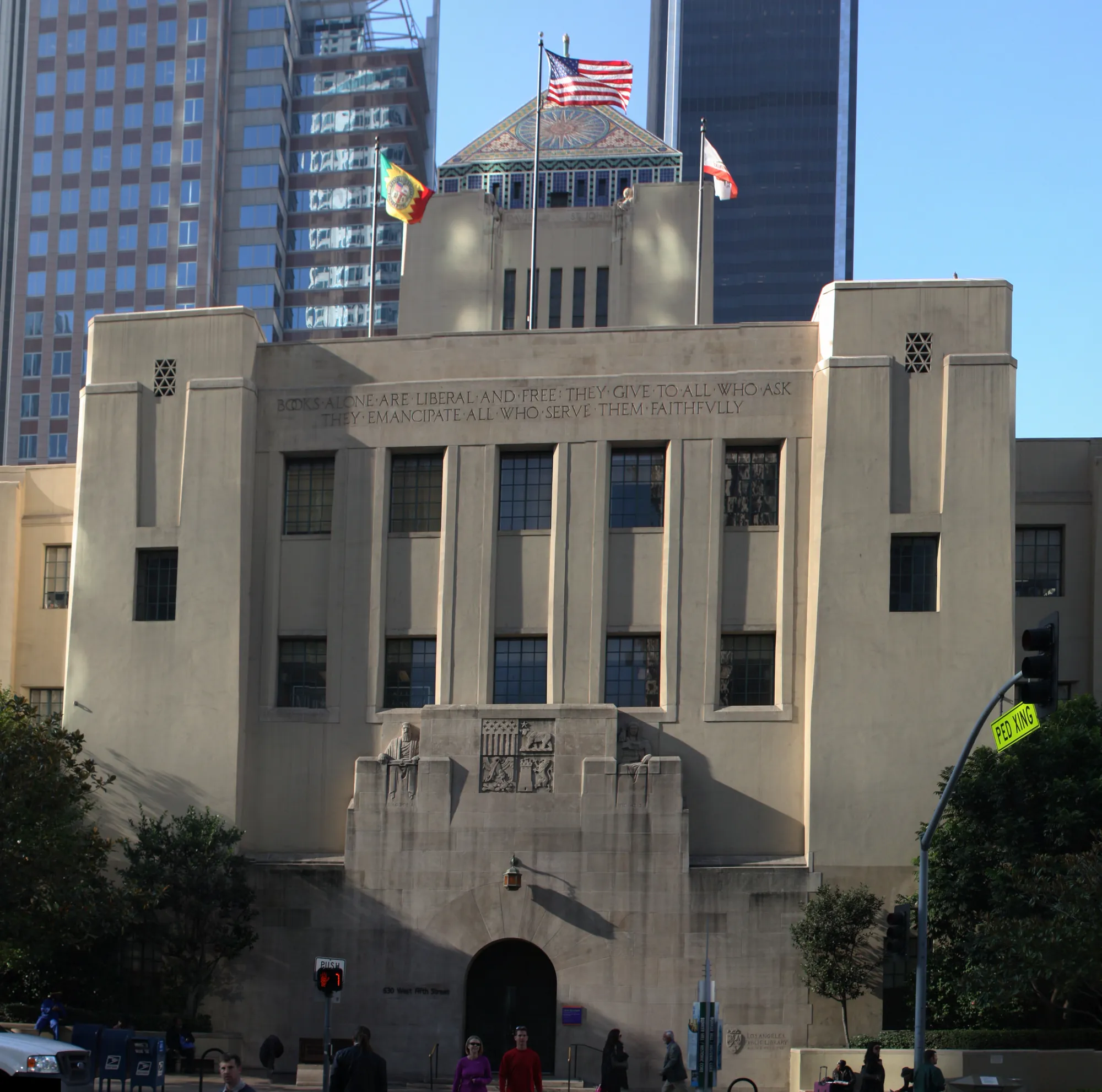
At the Los Angeles Central Public Library, the overall tower first registers against the city, then the facade opens into a program of figures and symbols. The library describes the Goodhue Building as an early Art Deco landmark whose monumental simplicity supports ambitious decorative sculpture. That pairing offers a useful way to look at other libraries: notice how the large form creates a stage for the smaller details.
Read the entrance as an invitation
The entrance is where an Art Deco library most clearly turns movement into meaning.
Read More
Notice the doorway before reading every detail. Is it set into a deep recess or held close to the street? Are figures flanking it, rising above it, or cast into the doors themselves? Does a sign name the institution plainly, or does lettering become part of a larger visual rhythm? A good entrance gives a visitor a first reading of the place before any room is entered.
Lee Lawrie’s work is especially useful here because he did not treat sculpture as a freestanding object placed beside a building. The Los Angeles Public Library’s account of the Goodhue Building explains that its exterior and interior sculpture was designed as an integrated program. Reliefs remain part of the wall, while figures, doors, and signs make the building’s ideas visible at different distances.
Try standing across the street first, then moving slowly to the door. The first view reveals silhouette and scale. The second reveals how shadow, stone, metal, and lettering shape the threshold. That change in distance is essential. Art Deco often uses a bold public gesture to bring visitors close, then rewards them with details made for the pace of walking.
Look for symbols of knowledge, not just decoration
The strongest library ornament gives a building’s purpose a visible language.
Read More
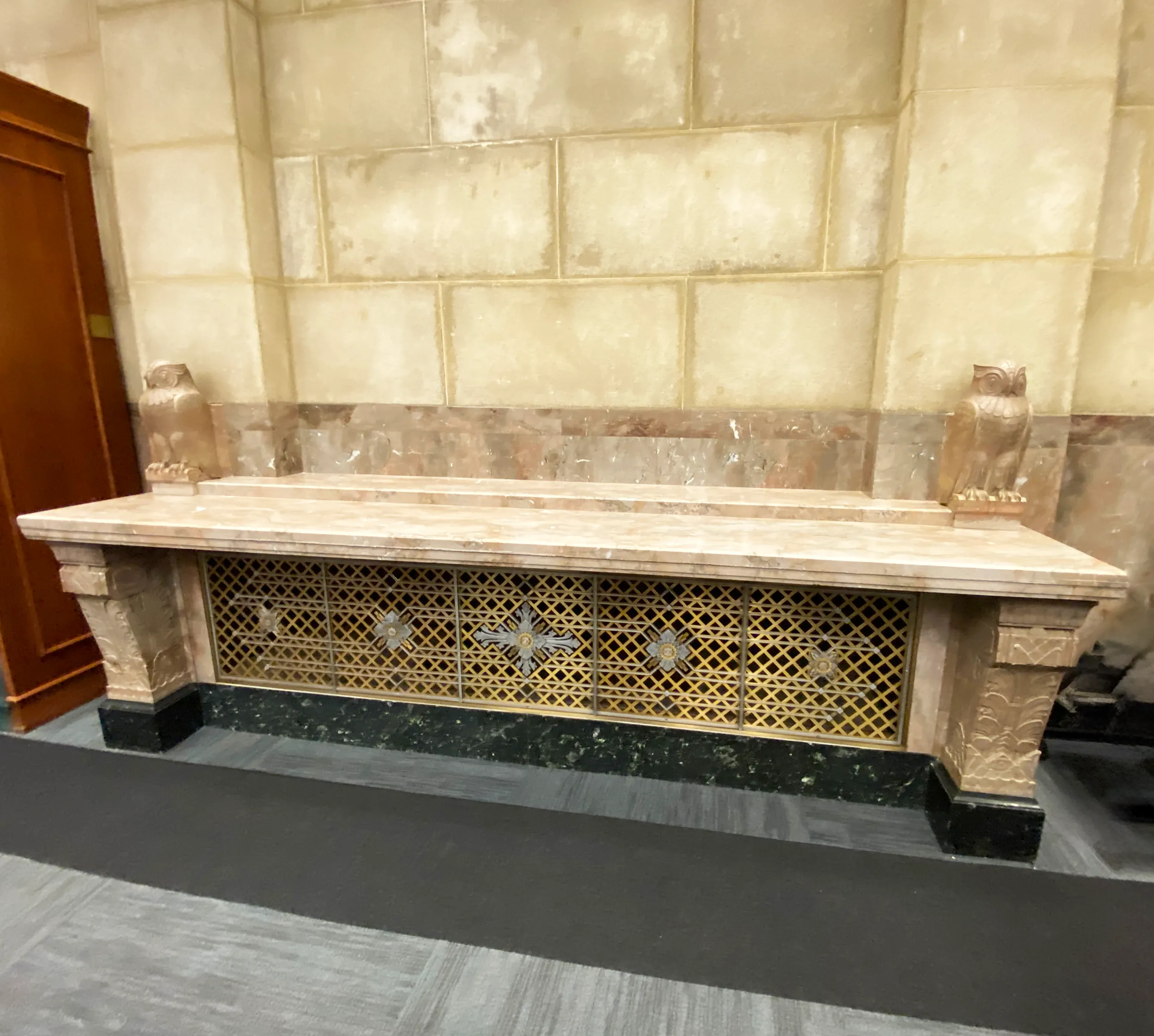
Owls, scribes, lamps, books, plants, animals, great thinkers, and abstract signs can all appear in a library, but their position matters as much as their subject. An owl above a doorway may sharpen the identity of a reading room. A scribe on a door can make the act of entry feel connected to the history of writing. A repeated leaf or geometric motif can quietly bind a lobby together without asking to be read as a separate work of art.
The John Adams Building of the Library of Congress is rich with this sort of visual language. The Library of Congress notes that Lawrie designed the building’s bronze doors, grille work, elevator ornament, and other details, while its virtual tour identifies Lawrie’s sculpted figures of Odin and Quetzalcoatl at an entrance. These are not random historical references. They make writing, invention, learning, and the preservation of knowledge part of the building’s everyday surfaces.
When you encounter a symbol, ask two questions: what idea does it carry, and why is it placed here? A figure at a busy entrance has a different job from a small ornament near an elevator or reading room. That simple distinction prevents decorative details from becoming a checklist. It restores them to the sequence visitors actually experience.
See modern form and old stories working together
Art Deco libraries often look forward through forms that also remember earlier cultures.
Read More
This mixture can seem surprising at first. A building may have a streamlined outline, crisp verticals, and modern materials, yet feature ancient writers, mythic figures, historic scripts, or medieval scholars. The point is not to make a museum of borrowed images. It is to show that a library carries knowledge across time while serving a very present public.
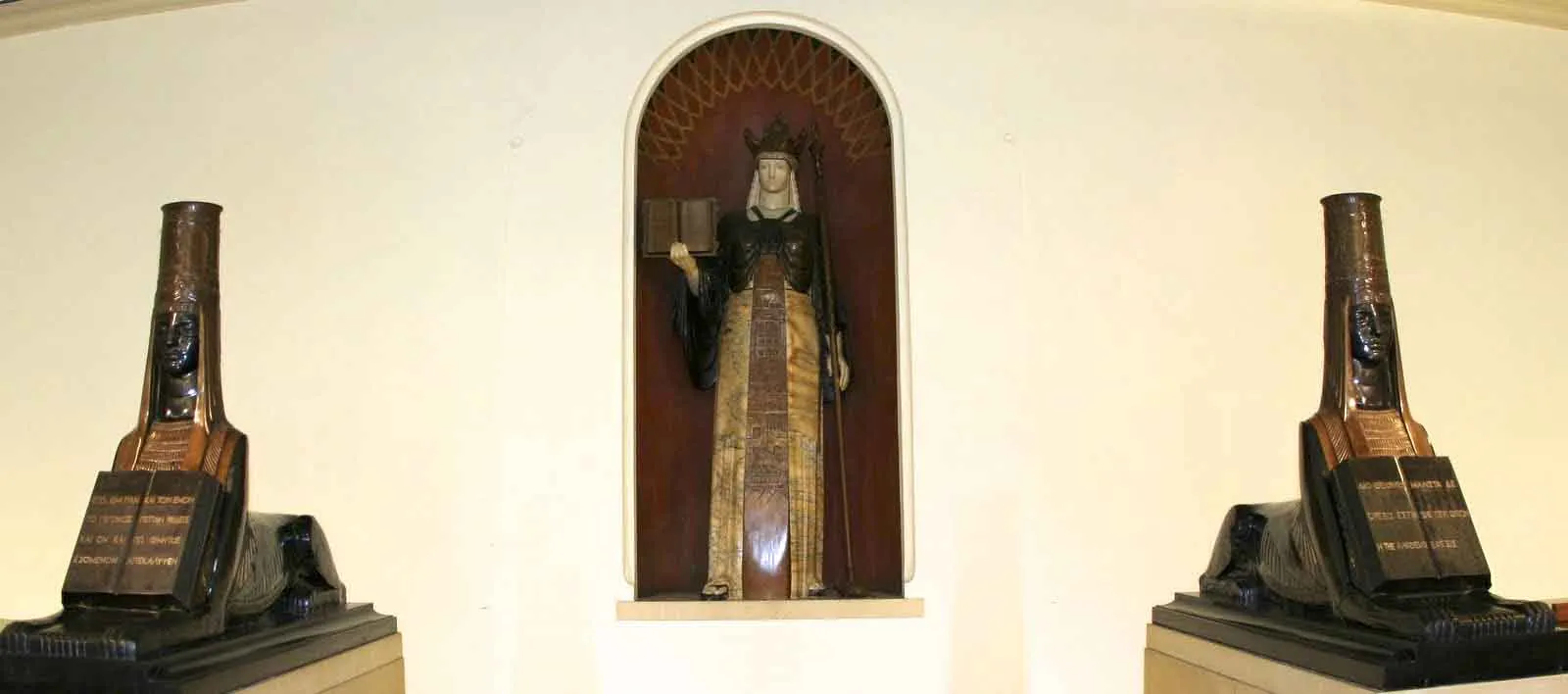
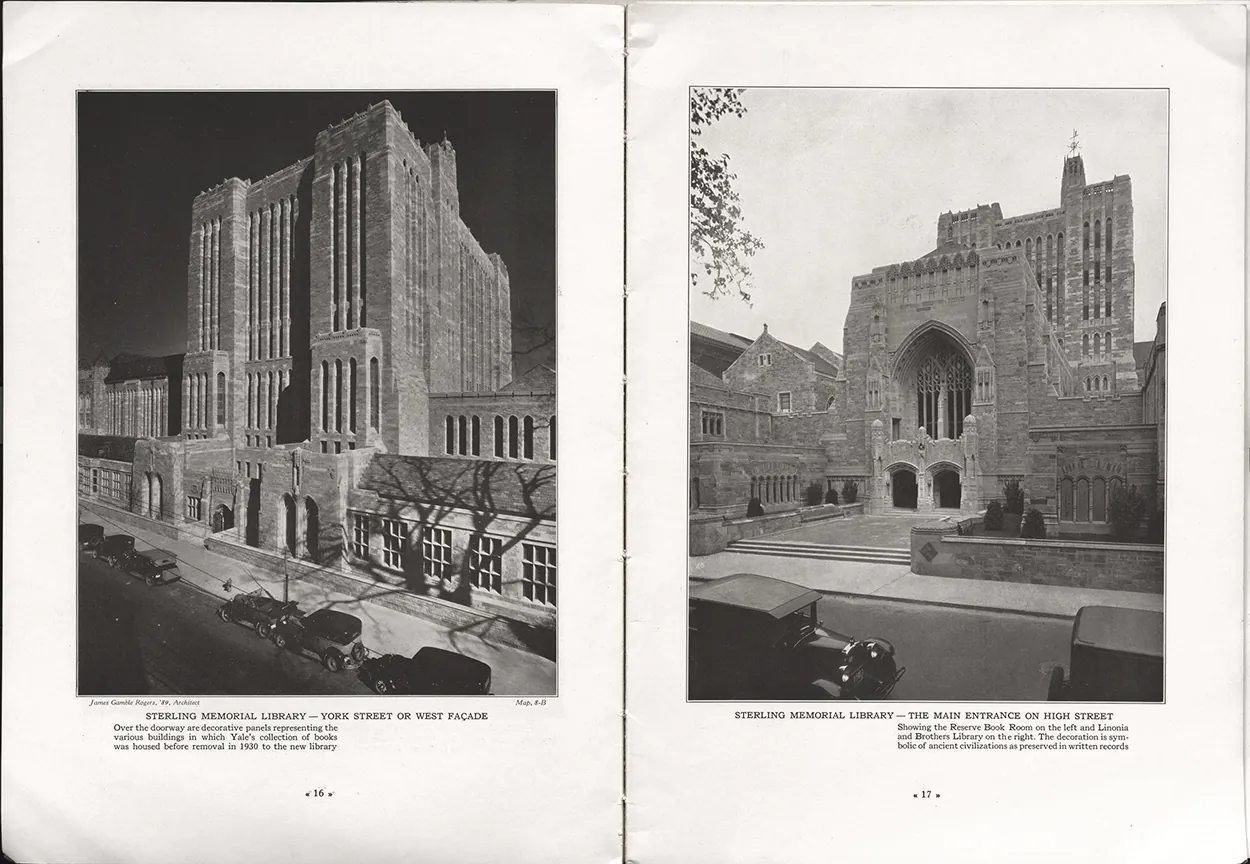
At Sterling Memorial Library at Yale, Lawrie’s High Street entrance is organized around civilizations preserved through writing. The archive records a central medieval scholar, figures and symbols connected with earlier civilizations, and inscriptions in multiple writing traditions. The program turns an entrance into a compact argument about study: knowledge is inherited, translated, and kept alive through people who read and record it.
That idea helps explain why Art Deco is more than a look. A building can use geometry and stylized ornament to make a visual order, then use its subjects to make that order meaningful. The modern form keeps the composition clear. The older stories add depth to what a library promises to protect and share.
Move from the landmark to the close detail
Looking at an Art Deco library in stages reveals how the building guides attention.
Read More
- Find the landmark. Start from a distance and identify the tower, silhouette, entrance, or strongest vertical line.
- Study the threshold. Notice stairs, doors, lettering, reliefs, and figures that prepare you to enter.
- Read the symbols in place. Ask how an owl, scribe, book, lamp, or inscription relates to the room or route around it.
- Look for materials and repetition. Compare stone, bronze, glass, tile, and metalwork, then see how a motif returns across different surfaces.
- Slow down indoors. Libraries frequently keep their most human-scale details in lobbies, stairs, doors, reading rooms, and elevators.
This method works whether a building is a famous landmark or a modest neighborhood branch. Not every library will have a full sculptural program, but many preserve the same concerns: a dignified entrance, clear lettering, durable materials, and details that make learning feel public rather than hidden away. Looking in this order helps distinguish a meaningful architectural composition from a collection of isolated motifs.
Why Lee Lawrie’s libraries matter
Lee Lawrie’s library work shows how an institution can make its purpose visible without losing the calm needed for reading.
Read More
At Los Angeles Central Library, the library’s architectural history identifies Lawrie’s work across exterior sculpture, the North Staircase, lighting, and decorative programs. At the John Adams Building, the Library of Congress describes Lawrie’s hand in door grilles, elevator ornament, plant motifs, and owls. His work is persuasive because it operates at every scale, from an image seen across a street to a small detail encountered on the way to a book stack.
The archive makes those ideas easier to study in context. Explore the Los Angeles Central Public Library, the Legendary Scribes, and the Sterling Memorial Library to see how the same artist adapted sculpture to different audiences and institutions. For another way to read those relationships, continue to the archive’s guide to architectural sculpture.
Frequently asked questions
What makes a library Art Deco?
An Art Deco library often combines a clear overall form with carefully placed decoration, including geometric ornament, stylized figures, metalwork, lettering, and materials that reward a closer look. The strongest examples use those details to express the library’s purpose as a place for knowledge and public life.
Are Art Deco libraries only found in large cities?
No. Art Deco appeared in libraries of many sizes, as well as in schools, courthouses, post offices, and other civic buildings. Look for a strong entrance, deliberate lettering, repeated geometric details, and symbols connected to learning or local life.
Why did Lee Lawrie make sculpture for libraries?
Lee Lawrie treated sculpture as part of architecture. At libraries, his figures, doors, reliefs, and ornament helped make learning, writing, memory, and public knowledge visible as visitors approached and moved through the building.
How should I look at an Art Deco library?
Start with the building from a distance, then study its entrance and lettering before moving indoors to doors, metalwork, lights, reliefs, and other details. The sequence shows how large architectural form and small decorative choices work together.
Related posts
 Art Deco
What Is Art Deco Sculpture? Definition, Features, and Examples
Art Deco sculpture uses simplified forms, strong geometry, and symbolic detail. See how figures, reliefs, doors, and ornament give a building its character.
 Art Deco
 Buildings: 5 Features to Look For
Learn the five features that make Art Deco buildings distinctive, from stepped skylines and grand entrances to materials, sculpture, and civic symbols.
 Art Deco
Famous Art Deco Artists: 6 Ways to See the Style
Meet famous Art Deco artists, including Tamara de Lempicka, A. M. Cassandre, Erté, René Lalique, and Lee Lawrie.
 Art Deco
Famous Art Deco Sculptors: 3 Artists and Their Work
Meet François Pompon, Waylande Gregory, and Lee Lawrie, then see how Art Deco sculptors used form, material, and setting to shape public places.