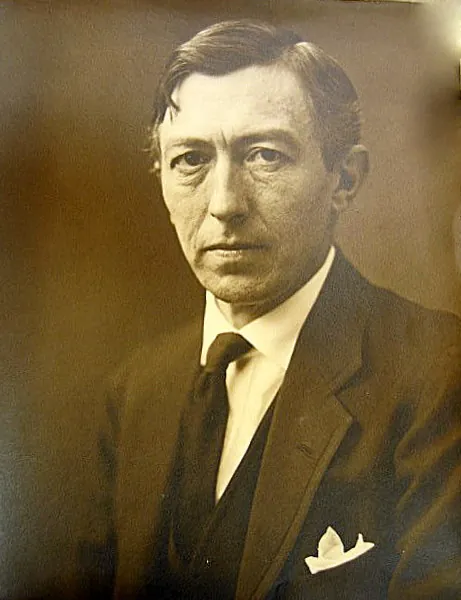
A list of Art Deco artists can be a useful starting point, but it rarely explains what made their work feel like part of the same moment. Art Deco moved through paintings, posters, glass, jewelry, furniture, theater, murals, and public buildings. The common thread was not one subject or one material. It was the ability to make modern life look deliberate, vivid, and memorable. This guide introduces a few useful names, then offers a better way to see how an artist’s work belongs to the style.
Start with the right question
“Who were the Art Deco artists?” sounds simple, but the category is broader than it first appears. A painter, a poster designer, a jeweler, and an architectural sculptor may have had very different careers while sharing a visual language of clean geometry, stylized figures, strong materials, and controlled drama. The Sotheby’s overview of Art Deco makes this range clear, placing graphic design, furnishings, architecture, jewelry, painting, and sculpture in the same larger story.
That breadth is a strength, not a problem to tidy away. Art Deco was made for public life: a poster had to catch the eye on a street, a glass object had to make light feel special, and a building had to turn an institution into a landmark. When you look at an artist, ask what their work was meant to do. Was it selling a journey? Setting a room’s mood? Giving a civic building a subject? The answer usually reveals more than a label alone.
See the artist through the medium
Tamara de Lempicka is often the name people meet first because her portraits make Art Deco’s polished glamour easy to recognize. Their carefully constructed figures, sharp light, and sculptural surfaces turn a sitter into a complete visual statement. The Metropolitan Museum of Art’s record for her 1939 Woman with Arms Crossed is a helpful close look at how painting can carry that controlled, modern presence without becoming architectural ornament.
A. M. Cassandre shows another route into the style. His posters reduced trains, ships, products, and letters to powerful arrangements of scale, type, and movement. The Museum of Modern Art’s account of his poster work notes the impact of his bold sans serif lettering and his work for Paris streets in the 1920s and 1930s. The subject changes, but the underlying skill is familiar: make a complex modern experience readable in a single glance.
That is why an artist list works best as a map, not a ranking. René Lalique’s glass and jewelry, Erté’s fashion and theatrical designs, Lempicka’s portraits, Cassandre’s posters, and Lee Lawrie’s sculpture each give the style a different public face. None needs to be treated as a substitute for the others. Together they show how far Art Deco could travel while keeping a recognizable appetite for rhythm, material, and form.
Look for the artist’s way of organizing attention
Art Deco artists often make the eye move in a planned sequence. A poster may send your attention from a large word to a streamlined machine. A portrait may turn a shoulder, glove, or diagonal shadow into a route across the canvas. A building can begin with a skyline silhouette, then bring you to an entrance, and finally reward a closer look with a relief, grille, or inscription.
This is the useful bridge between a graphic artist and a sculptor. They are not doing the same job, but both understand that a viewer’s first few seconds matter. Cassandre made distance and speed part of a printed image. Lawrie used height, placement, and human form to make architecture speak at the pace of a sidewalk. In both cases, the work is designed to be encountered, not merely cataloged.
Follow the work into its setting
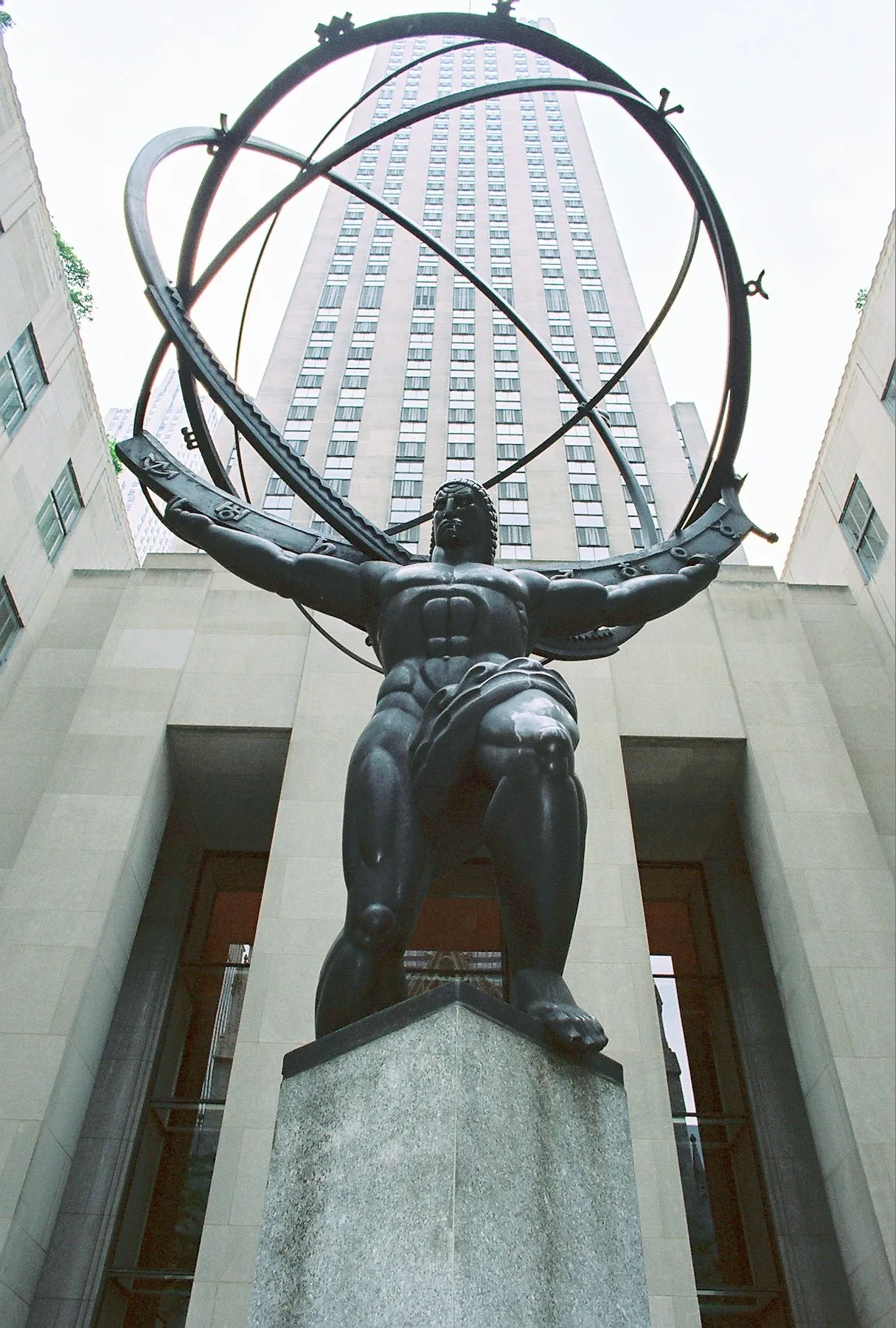
Art Deco is especially rewarding when the setting is still visible. An object in a case can show craftsmanship, but a sculpture on a building reveals why its form, size, and subject were chosen. Atlas at Rockefeller Center is a good example. The figure’s broad silhouette, armillary sphere, and placement at the International Building create a landmark before a visitor studies a single detail. The archive’s guide to Atlas follows that relationship between the bronze figure, Fifth Avenue, and the entrance it announces.
Lawrie’s work also makes clear why it is too narrow to think of Art Deco as a set of decorative motifs. His figures could embody knowledge, law, aspiration, or civic memory, but their meaning came from the building around them. The U.S. Commission of Fine Arts profile of Lee Lawrie records a career that brought sculpture into major American public projects. The archive lets you see that principle at a closer scale, from monuments to doors and architectural details.
Notice how collaboration shapes the result
It is tempting to imagine every Art Deco work as the expression of one celebrated individual. In practice, many of the most memorable examples are collaborative. An architect establishes the building’s form. A sculptor works with the facade, entrance, or interior program. Designers, fabricators, craftspeople, and letterers bring the material decisions into focus. The final effect feels unified because those roles were considered together.
The Nebraska State Capitol is one of the archive’s strongest lessons in this kind of coordination. Its tower, exterior figures, doors, murals, and interior detail are not scattered attractions. They make a long visual argument about the state, public life, and the people who shaped it. Looking at the work as a shared program gives the artists more credit, not less, because it shows the skill required to make many voices feel like one place.

Read symbols as part of a public purpose
Many Art Deco artists used figures, animals, machines, rays, plants, tools, and lettering. These are not always puzzles with one fixed answer. Often they are visual introductions to a place. A library may make learning visible through writers and thinkers. A bank may suggest security or circulation. A state capitol may turn law, labor, agriculture, or history into a sequence of images a visitor can encounter while moving through the building.
The archive’s Legendary Scribes at the Library of Congress John Adams Building offers a clear example. The figures are not simply added to a neutral wall. They make intellectual history present at the threshold of a library. That is a practical way to identify the best work in the style: look for an image that changes how you understand the place it inhabits.
Compare a distant view with a close view
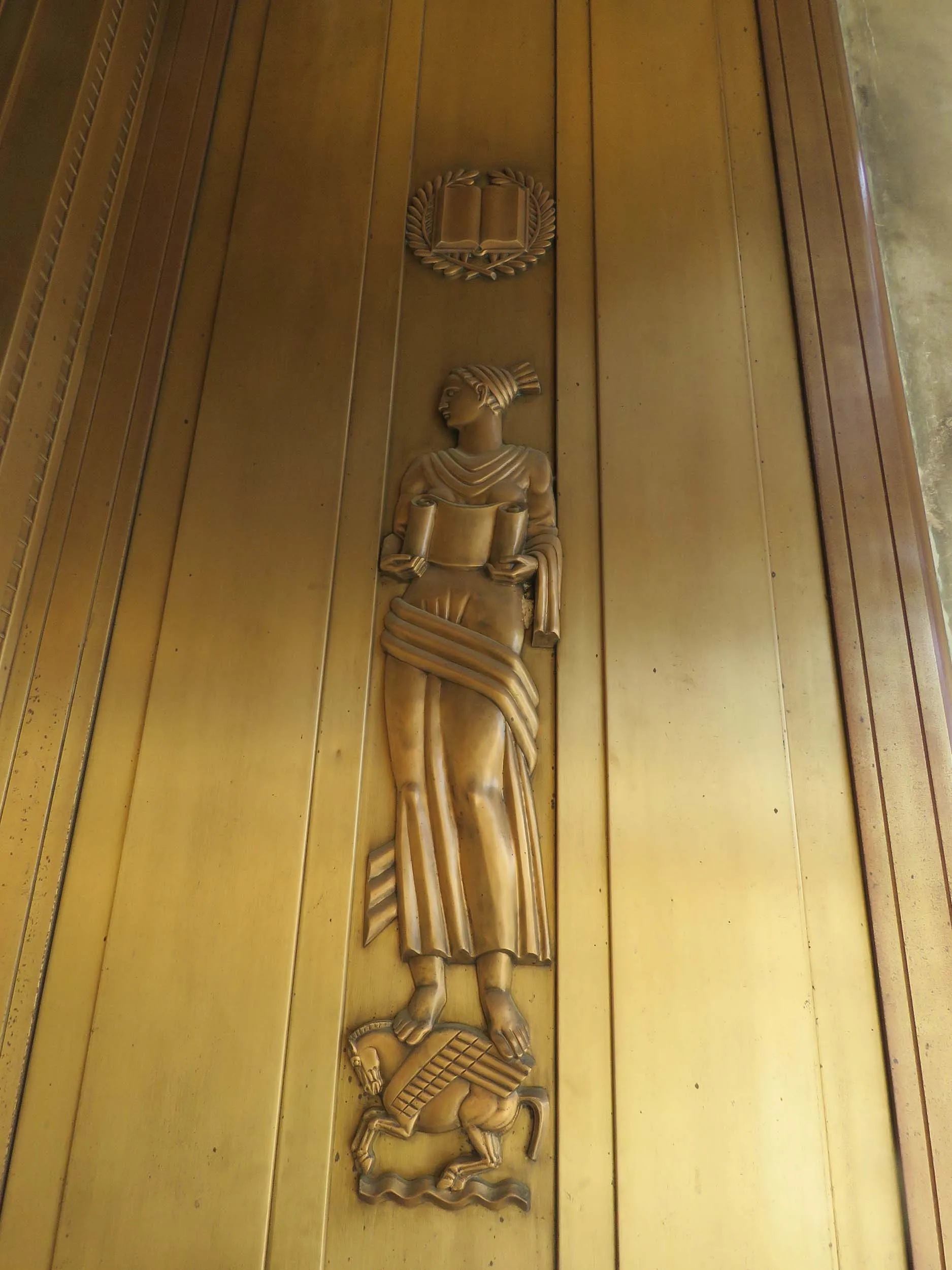
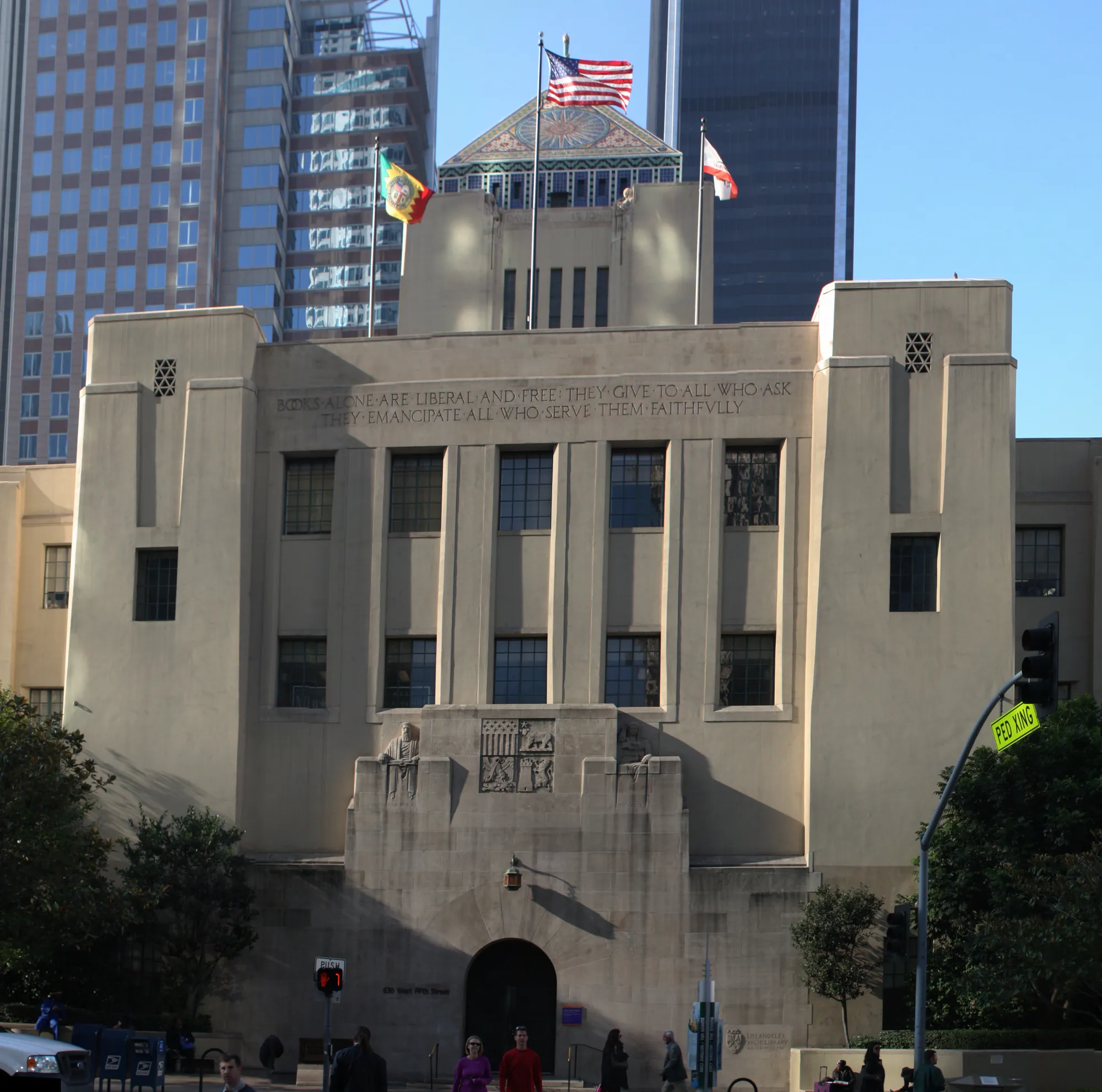
One of the quickest ways to understand an Art Deco artist is to change your distance from the work. From across a street, a building may look like a bold tower or a disciplined wall of vertical lines. At the entrance, it may reveal a different level of thought: a bronze grille, a carved inscription, a figure over a door, or a pattern built for the hand rather than the skyline. The artist has to make both experiences belong together.
The Los Angeles Central Public Library collection makes this shift easy to follow. Its tower establishes a clear presence in the city, while its reliefs, figures, and smaller details create reasons to slow down. That move from landmark to close encounter is more than visual variety. It is how an artist gives a large public building a human scale.
Pay attention to material, not just motif
Art Deco is often associated with gold, chrome, glass, and dark polished stone, but material matters because of what it does, not because it appears expensive. Bronze can make a figure read sharply against pale masonry. A glazed surface can catch light and make color seem active. A shallow relief can become dramatic when sunlight moves across it. Even a limited palette can feel rich when smooth and rough, bright and matte, deep and shallow surfaces have been deliberately paired.
This attention to material is another reason the category reaches beyond painting. A designer such as Lalique could make light, transparency, and detail the subject of an object. An architectural sculptor such as Lawrie could use stone, metal, and placement to control how a building met the street. The works look different, but both ask viewers to notice how a material changes an image’s force.
Use a six-part way to look
- Name the medium. Decide whether you are looking at a painting, poster, object, interior, or building before applying a style label.
- Find the strongest shape. Look for the silhouette, diagonal, figure, word, or repeated line that organizes the first impression.
- Trace the viewer’s path. Notice where your eye goes first, second, and last. A good Art Deco composition has a clear sequence.
- Look for purpose. Ask what the work is helping a person understand, buy, enter, remember, or admire.
- Move closer. Compare the large idea with details of lettering, texture, craftsmanship, or symbolic imagery.
- Put it back in context. Consider the room, building, street, client, and collaborators that gave the work its original job.
This six-part method is deliberately simple. It keeps the attention on what is in front of you while making room for the different kinds of artists who shaped the style. It also helps explain why one isolated photograph is rarely enough. The strongest Art Deco work changes as you approach it, and that changing experience is often the point.
Keep the label flexible, and the evidence specific
Not every artist working in the 1920s or 1930s was an Art Deco artist, and not every work by a familiar name belongs to the style. A long career may pass through several movements. A single building can combine Gothic, classical, modern, and Art Deco ideas. The best response is not to argue over a label in the abstract. Start with what the work actually does: how it uses line, proportion, material, subject, setting, and public purpose.
That approach also makes looking more fun. Instead of searching a facade only for zigzags, you can compare its large form with its entrance, its material contrasts with its figures, and its symbols with its institutional role. The archive’s guide to Art Deco buildings and guide to Art Deco sculpture offer a practical next step for that slower kind of seeing.
Why Lee Lawrie belongs in the conversation
Lee Lawrie gives this broad subject a useful center because his work shows how an artist can shape public space without treating art as an afterthought. At Rockefeller Center, the Nebraska State Capitol, the Los Angeles Central Public Library, and other landmarks, he worked at the meeting point of sculpture, architecture, civic identity, and daily experience. The archive’s profile of Lee Lawrie and its catalog of works make it possible to move from a general style question into individual objects and buildings.
For readers who want the richest single example, Prairie Deco follows Lawrie’s Capitol work in detail, from tower to interior. It is a reminder that the most lasting Art Deco art does not only look sleek in a photograph. It rewards returning, comparing, and noticing how every scale of a place has been made to matter.
Frequently asked questions
Who are some well-known Art Deco artists?
Artists often associated with Art Deco include Tamara de Lempicka in painting, A. M. Cassandre in posters and typography, Erté in fashion and theater design, René Lalique in glass and jewelry, and Lee Lawrie in architectural sculpture. They worked in different media, which is part of what makes Art Deco so wide-ranging.
Was Lee Lawrie an Art Deco artist?
Lee Lawrie worked in several styles across a long career, including Art Deco. His sculpture at Rockefeller Center, the Nebraska State Capitol, and the Los Angeles Central Public Library shows how figures and reliefs can become part of a building’s public identity.
How can I recognize Art Deco art?
Look for simplified forms, strong geometry, deliberate symmetry or repetition, a crisp silhouette, and a close relationship between image and purpose. In a poster, that may make a train or product feel monumental. In a building, it may make an entrance or civic idea easier to read.
Were all artists in the 1920s and 1930s Art Deco artists?
No. The period contained many overlapping styles and individual careers. It is more useful to look at the qualities of a particular work and its setting than to attach the label to every artist who worked between the wars.
Related posts
 Art Deco
What Is an Art Deco Sculpture? How to Read It on a Building
Learn what makes a sculpture Art Deco, then use five clear ways to read figures, reliefs, doors, and details on a building.
Art DecoArt Deco Buildings: How to See What Makes Them Work
A practical guide to reading Art Deco buildings through their silhouettes, entrances, materials, and sculpture.
 Art Deco
Art Deco Sculptors: How to Read Their Work
Learn how Art Deco sculptors used figure, material, symbol, and setting to make public buildings and everyday spaces speak.
Art Deco Painters: How to See Their Work
Meet the painters behind Art Deco’s sharp glamour, then learn how murals, portraits, and public spaces turned the style into a visual experience.