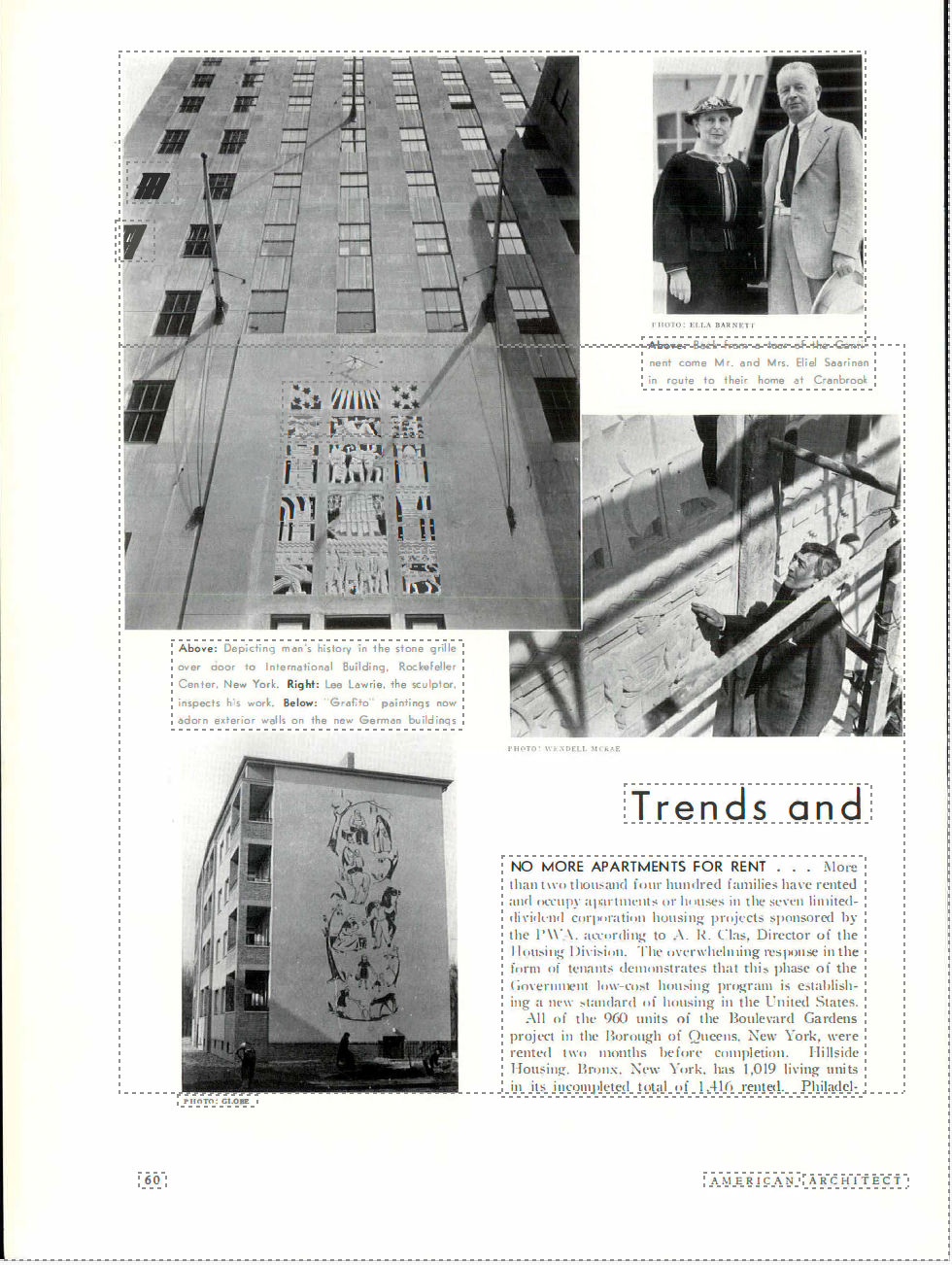
Atlas is one of New York’s most photographed sculptures, yet it is easy to see only the outline: a powerful bronze figure holding a circle against the Fifth Avenue skyline. A closer look reveals something more deliberate. Lee Lawrie and Rene Paul Chambellan made Atlas as part of an entrance, a street corner, and a larger Art Deco program. The best way to understand it is to slow down long enough to notice what the figure, sphere, and building are doing together.
Find Atlas on Fifth Avenue
Atlas stands at the entrance to the International Building at 630 Fifth Avenue, opposite St. Patrick’s Cathedral. That address matters. The sculpture is not in the sunken plaza with Prometheus, and it is not a detached object placed in the middle of Rockefeller Center. It marks a threshold between Fifth Avenue and the International Building, where the bronze, the building face, and the traffic of the avenue all meet.
The figure is hard to miss, but its position is carefully calculated for a moving audience. From the opposite sidewalk, the silhouette reads quickly: bent body, broad shoulders, large rings. From the building line, the work becomes an architectural frame. The sphere opens views toward the street and sky, while the building behind it gives the figure a fixed purpose. The visitor is not being asked to walk around a freestanding statue in a quiet garden. Atlas has to work at the pace of one of Manhattan’s busiest avenues.
That is a useful way to begin any visit. First, stand back across Fifth Avenue and look for the overall profile. Then cross closer to the International Building and notice how the sculpture changes. The same work can appear like a city-scale sign from one side of the street and like a richly worked entrance from the other. The contrast is one of Lawrie’s great skills: making sculpture clear at a distance without making it empty up close.
Who made Atlas?
Atlas was designed by Lee Lawrie with Rene Paul Chambellan. Lawrie is one of the artists most closely associated with America’s great early twentieth-century buildings, and the U.S. Commission of Fine Arts identifies Atlas as one of his best-known works. Chambellan was an important collaborator at Rockefeller Center whose decorative and sculptural work appears throughout the complex.
Lawrie’s career makes the pairing especially significant. The Smithsonian American Art Museum’s artist record traces a body of work that ranges across churches, libraries, memorials, and major civic commissions. At Rockefeller Center, he was not designing an isolated memorial to be approached in silence. He was helping create a public environment that had to communicate in seconds to people arriving on foot, by car, or from the surrounding offices.
Knowing that collaboration helps the sculpture make more sense. Architectural sculpture is rarely the result of one isolated gesture. A project at this scale has to move through design, modeling, fabrication, materials, installation, and the practical demands of a specific facade. Atlas has the concentration of a single figure, but it was created for a collective building program where architects, artists, fabricators, and planners had to make their work hold together.
That is why the work avoids the feeling of a figure dropped in front of a building. The bronze has enough presence to stop a passerby, yet the pose, pedestal, and sphere continue the upward movement of the International Building. The composition is both sculptural and architectural. It provides a memorable subject for a photograph, but its more lasting job is to make the entrance feel purposeful before a visitor has even crossed the threshold.
It also prevents a familiar mistake. Atlas is often treated as a generic symbol of Rockefeller Center, which it certainly has become. But it is more specific than that. It belongs to Lawrie’s long career of giving public buildings a symbolic face. The archive’s Rockefeller Center collection places Atlas beside Lawrie’s other work at the complex, while the wider catalog of works shows how often he used sculpture to make an entrance, tower, library, or civic building memorable.
What Atlas is carrying
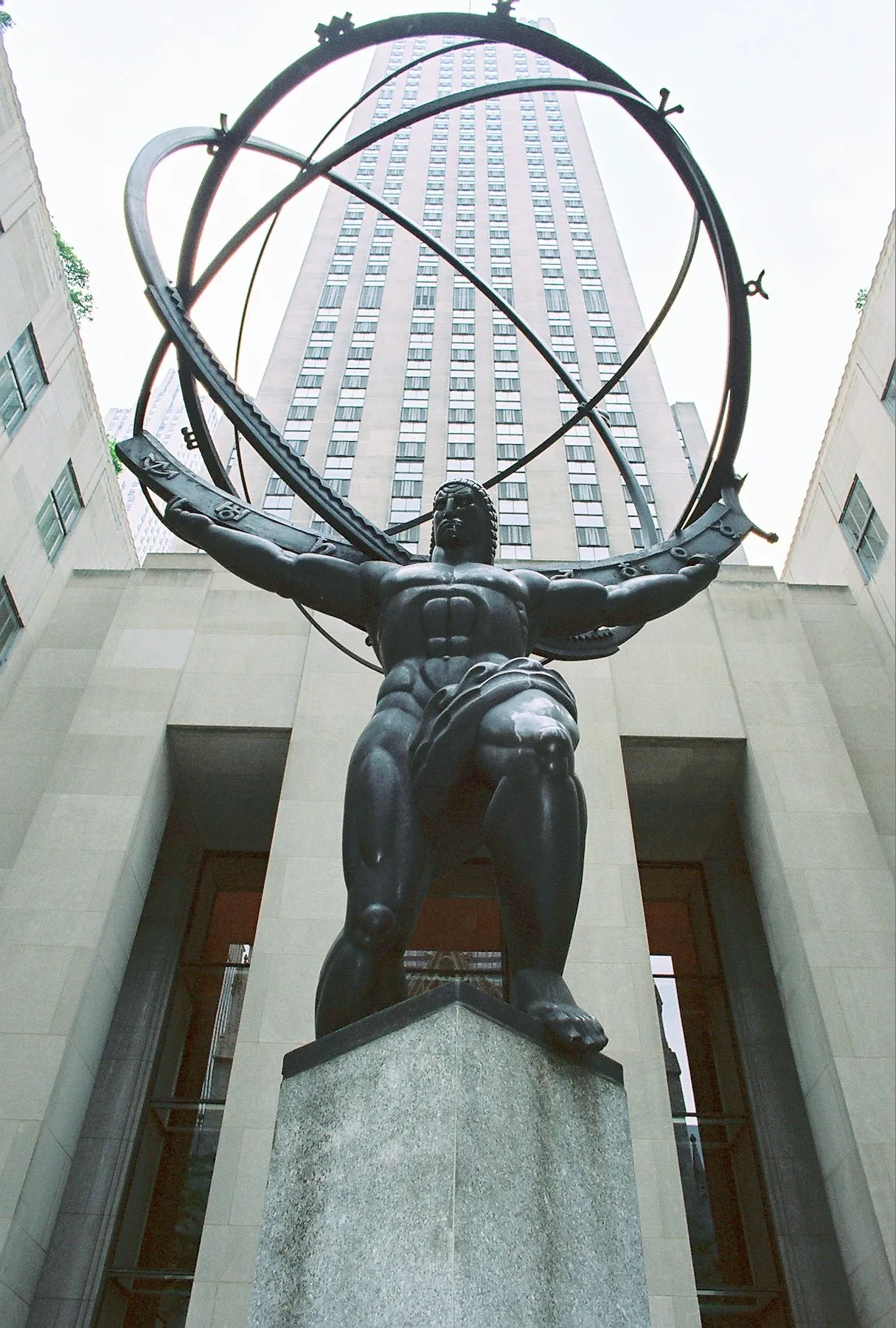
Atlas is usually described as carrying the world. That shorthand is understandable, but it misses the defining object in the composition. The figure supports a celestial vault, often called an armillary sphere. Its open rings represent the heavens rather than the surface of the Earth. This is why the work feels different from a simple display of strength. The burden is cosmic, ordered, and intellectual as well as physical.
The distinction reaches back to the Greek story. Atlas is the Titan condemned to bear the sky, not a porter holding a globe. At Rockefeller Center, the sphere makes that myth visible in a modern form. The rings keep the figure from becoming a solid bronze mass, and they let air, light, and the surrounding city enter the composition. Viewed from behind, the sphere can frame St. Patrick’s Cathedral and Fifth Avenue. Viewed from the side, it becomes a graphic drawing in space.
The scale is part of the effect. The bronze figure is about 15 feet tall. With its pedestal, the monument rises roughly 45 feet, and the sphere is about 21 feet across. Those measurements, collected in a detailed guide to Atlas and Prometheus, explain why photographs can feel misleading. A close photograph may show the force of the body or the geometry of the rings, but it cannot quite convey how much of the street the sculpture commands. Stand far enough back to see the full relationship between pedestal, figure, sphere, and facade.
The sphere also gives the sculpture an unusual rhythm. A solid globe would make the composition heavy and closed. The open rings let the work breathe. They introduce curving lines that counter the vertical stone of the building and change as people move along the sidewalk. In one view, the rings seem to surround the figure. In another, they become a set of lines drawn across the facade. That controlled change is one reason Atlas can feel alive even though its pose is fixed.
How to look at Atlas in five minutes
- Start across Fifth Avenue. Look for the full silhouette before studying any detail. The body and sphere need to read at city scale.
- Move toward the corner of the pedestal. Notice how the monument is set at the building edge rather than centered in an open plaza.
- Look through the rings. The armillary sphere changes with each viewpoint. It opens and closes against the avenue, the sky, and the building.
- Study the figure’s stance. Atlas is not simply standing upright with a burden. The compressed pose makes strain, balance, and endurance part of the design.
- Step back once more. After seeing the details, return to the opposite sidewalk. The sculpture’s clarity at distance is easier to appreciate once you know what it contains.
This short sequence is more rewarding than trying to find one perfect camera angle. Architectural sculpture changes with distance, weather, traffic, and the direction of the light. Bright sun can sharpen the silhouette and metal surface. Overcast light can make the figure’s planes easier to read. The best view is not fixed, because the sculpture was made to work with the city in motion.
It is also worth looking at the work twice, once on the approach and once after you have seen the building entrance. On the first pass, Atlas can seem to be a single emphatic image. On the second, the relationship between the figure and the International Building is much clearer. The figure carries the sky, but the building gives that burden a practical role: it announces a place devoted to international commerce, travel, and exchange at the edge of one of the city’s great avenues.
Atlas and Prometheus are not the same story
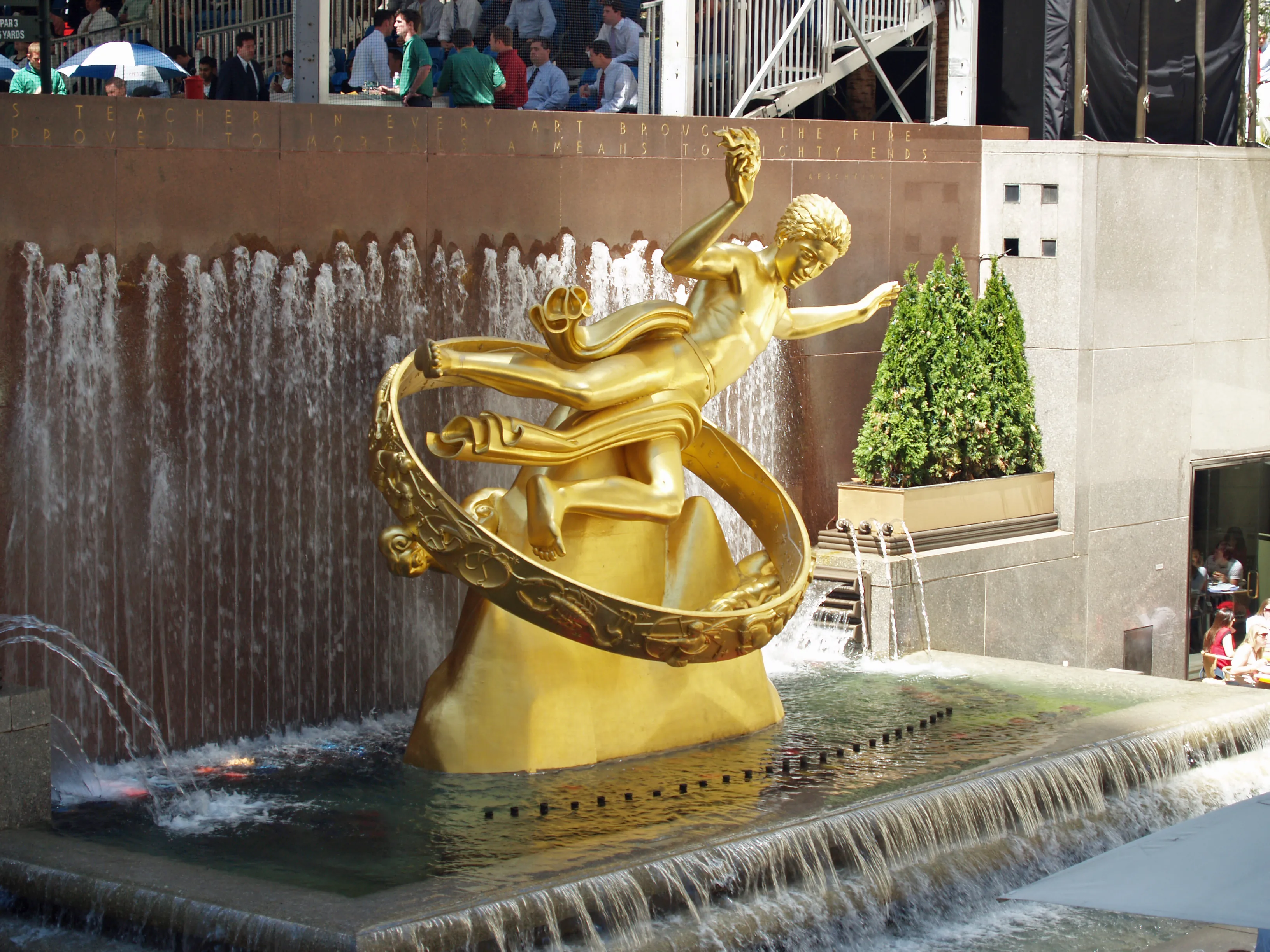
Atlas is often paired with Prometheus because both are giant figures drawn from Greek myth and both are among Rockefeller Center’s best-known works. They are also easy to confuse for a visitor seeing the complex quickly. Prometheus is the gilded figure in the lower plaza. Atlas is the dark bronze figure on Fifth Avenue at the International Building. They occupy different architectural settings, and they were made by different sculptors.
The difference is useful because it shows how varied Rockefeller Center’s public art can be. Prometheus is a dramatic centerpiece in a sunken gathering place. Atlas is an entrance monument that confronts the avenue. One is closely tied to the plaza experience. The other turns a building threshold into a landmark. Seeing both makes it easier to understand why the complex still feels so carefully composed nearly a century later.
The contrast also changes the visitor’s route. Prometheus is usually encountered as part of the plaza, surrounded by the rink, gardens, seasonal activity, and the broad view toward 30 Rockefeller Plaza. Atlas works in reverse. It catches the eye from the street, then sends the viewer toward the building. One sculpture gathers people into a public room. The other gives an edge of the complex a strong outward face.
There is no need to choose a favorite. The value of seeing both is that they make Rockefeller Center’s art program feel more intentional. Myth is not simply used as decoration. Different myths are assigned different jobs, different materials, and different settings. Once that pattern becomes visible, other details in the complex begin to read less like isolated attractions and more like parts of a shared visual language.
Why Atlas matters in Lee Lawrie’s career
Atlas is a powerful introduction to Lee Lawrie because it makes his central strength easy to see. He did not treat sculpture as an optional ornament added after a building was complete. He used it to give architecture a symbolic identity. A figure could make an entrance ceremonial, make a tower legible from a distance, or give a public building a story that visitors could feel before they knew every detail.
That approach appears throughout the archive. The National Academy of Sciences Building, the Los Angeles Central Public Library, and the Nebraska State Capitol all show different parts of the same practice. Each commission has its own materials and meanings, but each asks sculpture to work with the life of a building, not merely sit beside it.
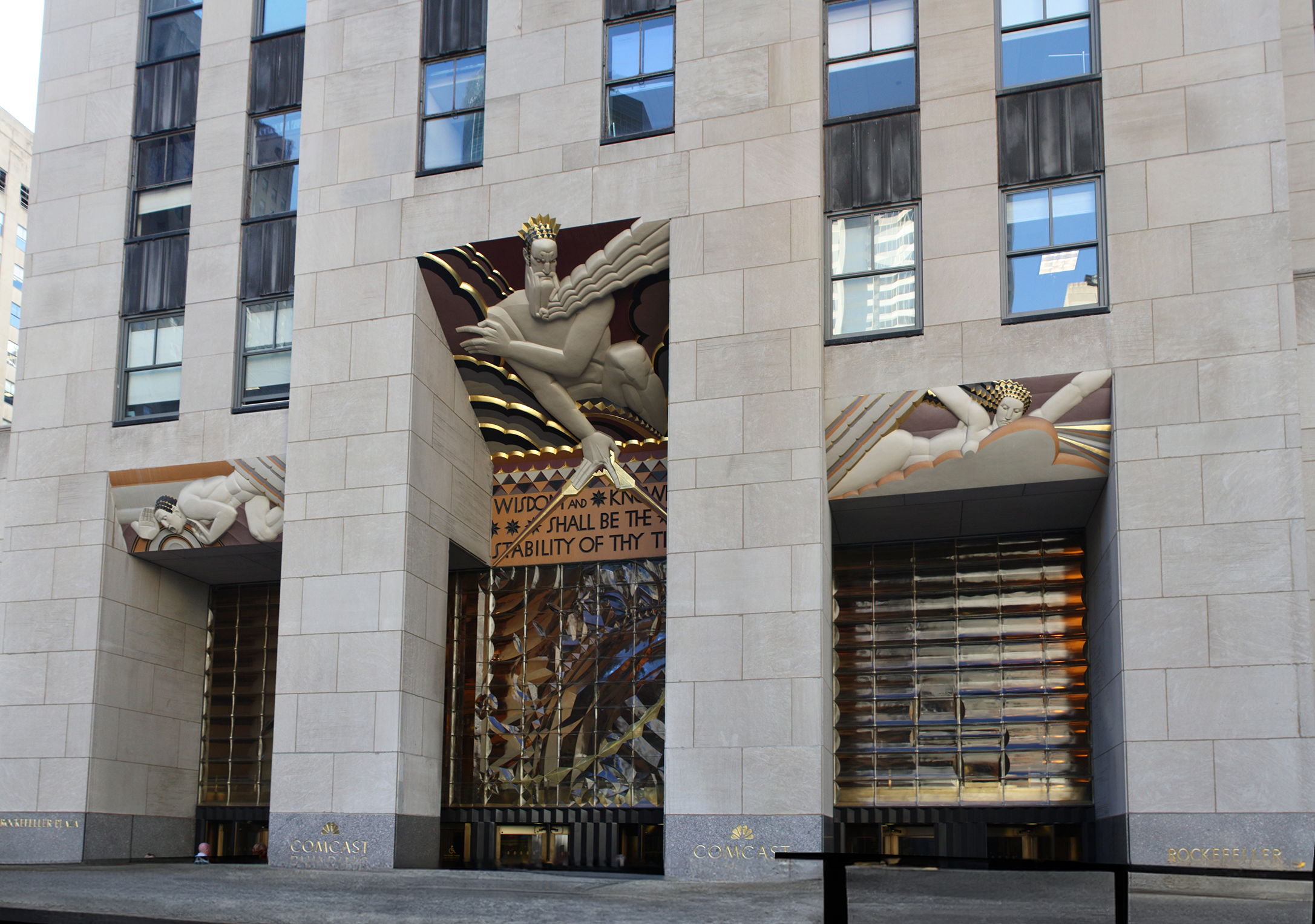
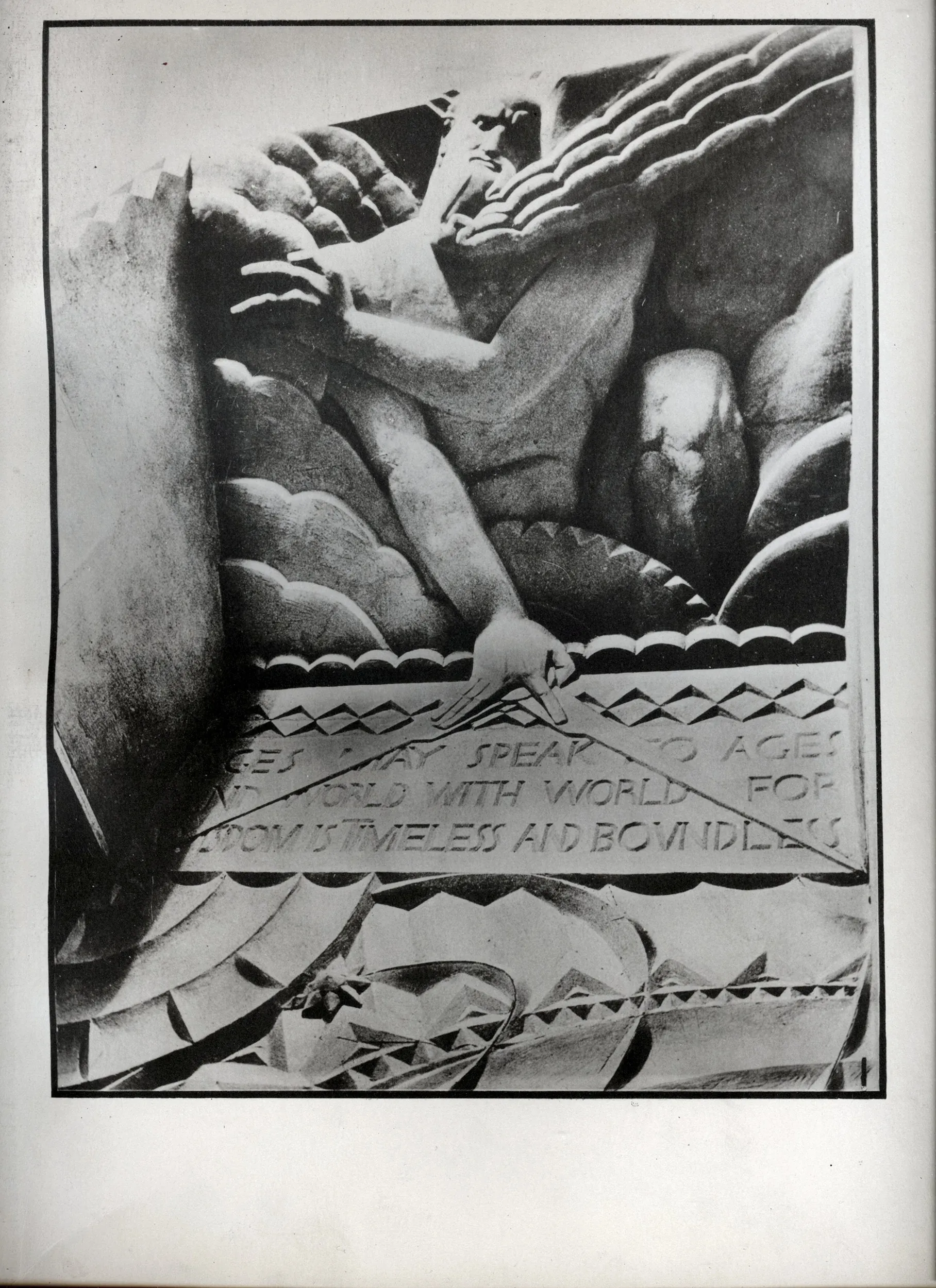
For a wider Rockefeller Center visit, continue with the archive’s guide to Lee Lawrie’s Rockefeller Center Art Deco work. It connects Atlas to Wisdom, the International Building, and the larger sculptural program. The archive’s research and photography are especially useful for visitors who want to move past the famous view and see how individual works belong to a larger, carefully planned whole.
Frequently asked questions
Who made the Atlas statue at Rockefeller Center?
Atlas was designed by Lee Lawrie with Rene Paul Chambellan, a leading architectural sculptor and ornamental designer of the period. The work is part of the International Building at 630 Fifth Avenue.
Where is Atlas at Rockefeller Center?
Atlas stands on Fifth Avenue at the entrance to the International Building, across from St. Patrick’s Cathedral. It is east of the central plaza, so it is not beside the gold Prometheus sculpture at the skating rink.
How tall is the Atlas statue?
The bronze figure is about 15 feet tall. With its pedestal, the full monument reaches about 45 feet, and the celestial sphere measures about 21 feet across.
Is Atlas holding the world?
Atlas is carrying a celestial vault, or armillary sphere, rather than a simple globe. Its rings represent the heavens, which makes the sculpture a more exact image of the mythological burden than a figure holding the Earth.
Related posts
Rockefeller Center ArtRockefeller Center Art Deco: A Guide to Lee Lawrie
A practical guide to finding Atlas, Wisdom and the larger sculptural program that Lee Lawrie helped shape at Rockefeller Center.
 Rockefeller Center Art
Prometheus Statue at Rockefeller Center
Find the gilded Prometheus statue at Rockefeller Center, learn its meaning and artist, and see how it shapes the Lower Plaza.
Rockefeller Center ArtWisdom at Rockefeller Center: A Closer Look
A guide to Lee Lawrie’s great entrance relief at 30 Rockefeller Plaza, its famous inscription, and the details that reward a slower visit.
 Rockefeller Center Art
Lee Lawrie, Sculptor of America’s Great Buildings
Who was Lee Lawrie? Meet the architectural sculptor whose work shaped the Nebraska State Capitol, Rockefeller Center, libraries, memorials, and more.