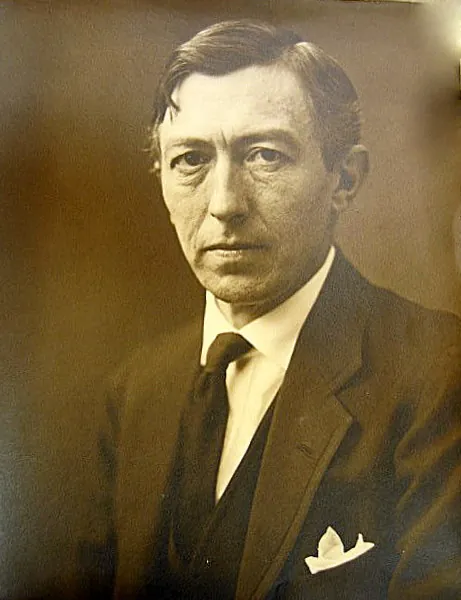
Born Max Leo Hugo Belling in Rixdorf, Prussia, Lee Lawrie came to the United States as a child and found his vocation in a Chicago sculptor’s studio. His career would span Gothic revival, Beaux-Arts classicism and Art Deco.
Lawrie worked with Bertram Goodhue for decades and gave sculpture a central role in public architecture. From the Nebraska State Capitol to Rockefeller Center, his figures, doors, friezes and details joined art to the daily life of buildings.
Many of the images in this archive are more than a century old. They have been clarified where needed to make their details easier to see, without altering or distorting the original record.
Many of Lawrie’s official photographs were taken by R. V. Smutney, his original documentary photographer.
Logistics
Lawrie’s studio at 1923 Lexington Avenue in Harlem occupied a huge early twentieth-century former parking garage. He employed as many as fifteen to twenty studio assistants.
Joseph Kislewski, one of those assistants, said that Lawrie had boundless energy and worked nearly all his waking hours, fueled by coffee and cigarettes.
Lawrie was known to model clay rapidly. Once a sculpture was properly modeled, it was recreated in plaster.
The plaster models were crated and sent by rail to the construction site. Lawrie used crews of mostly Italian stone carvers, directed by Eddie Ardolino, who enlarged the plaster models with calipers and air chisels.
For the most part, the figures were carved in situ, directly on the building. At the Nebraska State Capitol, sheds and scaffolding were hung from the sides of the building so workers could carve stone already laid in place.
Ardolino could be trusted to execute the carving faithfully. That allowed Lawrie to remain in Harlem, continuing to work and produce sculpture on a large scale.
This is why he is the Machine-Age Michelangelo. His output was phenomenal, not just in style but in sheer mass. He worked on several projects at once, and the 1920s were the most productive phase of his career.
Modern Americans can order goods online and receive them the next day. Lawrie worked with telegrams, a still-primitive telephone, horse-drawn wagons and steam-powered trains.
Lawrie sometimes traveled to building sites to inspect the work, crossing the nation by train. Travel to Goodhue’s Hawaiian buildings would have required an ocean-liner voyage. Air travel was practically nonexistent in the 1920s.