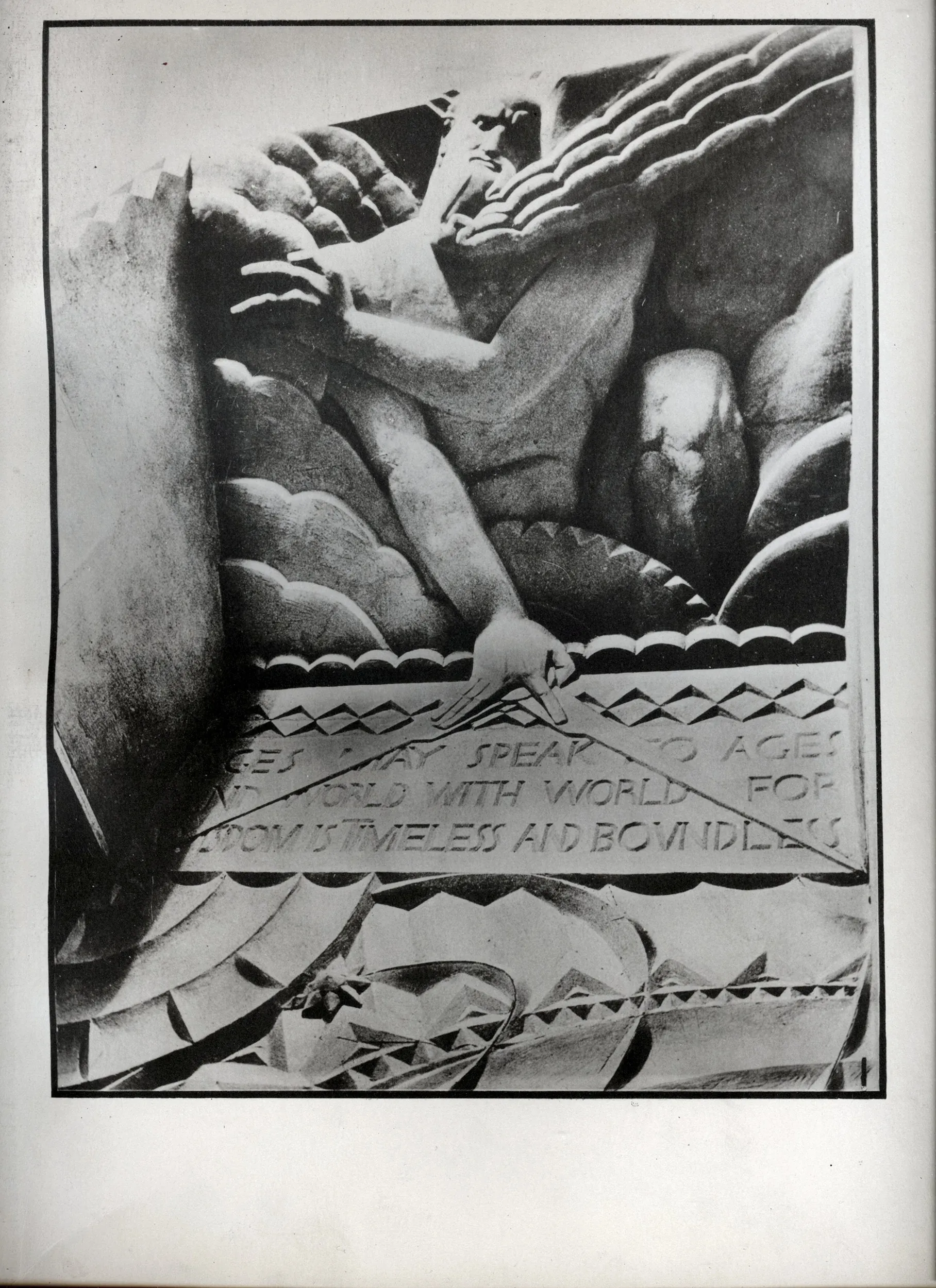
Lee Lawrie, Hildreth Meiere, Bertram Grosvenor Goodhue and Raymond Hood each worked within a network that made functional and beautiful architecture possible.
Greg Harm has studied the life and work of architectural sculptor Lee Lawrie since 2000, when he first noticed a connection between his native Nebraska and the architectural firm Cram, Goodhue & Ferguson.
Both Lawrie and mosaicist Hildreth Meiere made significant contributions to Rockefeller Center. The Center’s construction was completed several years after the Nebraska State Capitol, designed by Bertram Grosvenor Goodhue.
Goodhue and Associates won the design competition for the Nebraska State Capitol in 1921. Lawrie and Meiere were collaborators in the Capitol’s sculptural and decorative programme, and both later worked at Rockefeller Center during the height of the Great Depression.
As the Depression paralysed most new construction in the 1930s, Rockefeller Center emerged as a monument to commerce and a jobs project for hundreds of skilled craftspeople who had been left idle. Among the prominent artisans seeking opportunities, Lawrie and Meiere secured commissions for the forthcoming centre.
It may have been coincidence, but both Lawrie and Meiere had worked with Goodhue on the Nebraska State Capitol and had at least a minimal connection with Raymond Hood, Rockefeller Center’s chief architect. Hood had worked for Goodhue in the first decades of the twentieth century.
Harm recognised the connection between Goodhue, Lawrie, Meiere and Hood, and became absorbed by the question of how artisans who had worked on the Nebraska State Capitol gained national recognition before Rockefeller Center came into being.
The common thread was Raymond Hood: the architect from Pawtucket, Rhode Island, who worked for Bertram Goodhue in the 1910s.
Continue exploring