The best Art Deco landmarks do more than give a city a striking skyline. They direct the eye from a distant tower or facade to a doorway, a relief, a line of lettering, or a hand-sized piece of metalwork. That movement, from public image to close detail, is the key to understanding why these buildings remain memorable.
What makes an Art Deco landmark memorable?
Start with the whole building before looking for a familiar zigzag or sunburst.
Read More
Art Deco is often recognized through strong geometry, clean outlines, stylized ornament, and a confident use of modern materials. Yet a landmark is more than a collection of motifs. Its silhouette makes it recognizable from a distance, while its entrance and details give visitors reasons to slow down. The result is a building that works at the scale of a city and at the scale of a person walking through a door.
The style received its name from the 1925 Paris exposition that celebrated modern decorative and industrial arts, but American examples developed their own character. In civic buildings, libraries, offices, and cultural institutions, Art Deco often made modern construction feel ceremonial. A tower could signal public importance. A deep doorway could mark a threshold. Sculpture and ornament could explain the ideas a building represented without turning the facade into a textbook.
The History overview of surviving Art Deco landmarks points to the style’s sleek geometry, organic forms, and interest in both new technology and ancient cultures. Those traits are useful clues, but the most rewarding question is practical: how does the building guide your attention from its biggest shape to its smallest meaningful detail?
1. Nebraska State Capitol: read the building as a civic programme
The Nebraska State Capitol is a landmark because its tower, sculpture, mosaics, inscriptions, and rooms all contribute to one public argument.
Read More
From a distance, the Capitol’s tower gives the building a clear presence on the Lincoln skyline. Up close, the work becomes much more specific. Exterior figures and reliefs introduce themes of government, law, agriculture, and the history of the state. Inside, the themes continue through ornament, color, and carefully placed works of art. The building asks the visitor to read it in stages rather than absorb it all at once.
The National Park Service’s Capitol landmark resource guide describes its design as a distinctive combination of stripped classicism, Byzantine ornament, and Art Deco or Moderne influence. That mixture is important. It explains why the Capitol can feel modern and monumental without relying on one decorative formula.
Lee Lawrie’s sculpture gives the larger architecture a human scale. Begin at the Nebraska State Capitol collection, then compare a broad exterior view with the reliefs and interior details. The change in scale shows how sculpture can make civic ideas visible without breaking the building into separate attractions.

2. Rockefeller Center: let the entrance set the pace
At Rockefeller Center, Art Deco works through a sequence of streets, plazas, towers, doors, reliefs, and sculptures rather than through one isolated image.
Read More
Many visitors know Atlas or Prometheus before they know the larger sculptural programme. That is understandable, but it can make the complex seem like a collection of famous objects. A slower approach changes the experience. Look for how a sculpture meets an entrance, how an inscription sits above a door, and how stone, metal, color, and shadow help the work register at street level.
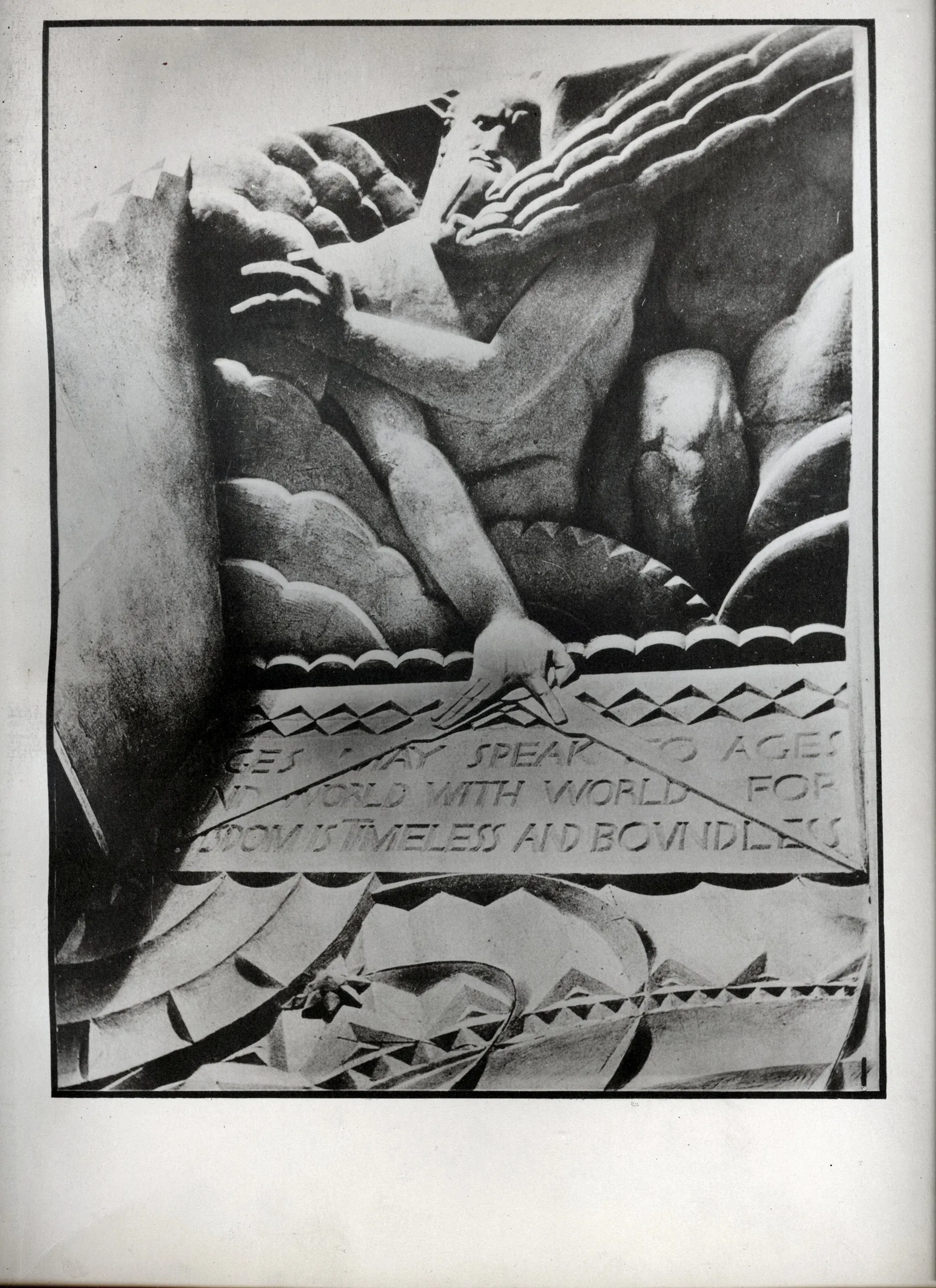
Lawrie’s Wisdom above the principal entrance to 30 Rockefeller Plaza is a particularly good place to practice. The Rockefeller Center art directory identifies it as a focal point of the entrance. Its scale and placement do not compete with the tower behind it. They make the act of arriving feel deliberate, turning an ordinary threshold into a place to pause and look.
The archive’s Rockefeller Center collection keeps that context intact. Follow it from the large public symbols to the smaller lions, reliefs, and architectural details. The best way to understand the complex is not to ask which sculpture is most famous, but to notice how each one helps establish a route through the place.
3. John Adams Building: find the story at hand level
The John Adams Building of the Library of Congress shows how an Art Deco landmark can make a public idea visible in the details a visitor touches and passes every day.
Read More
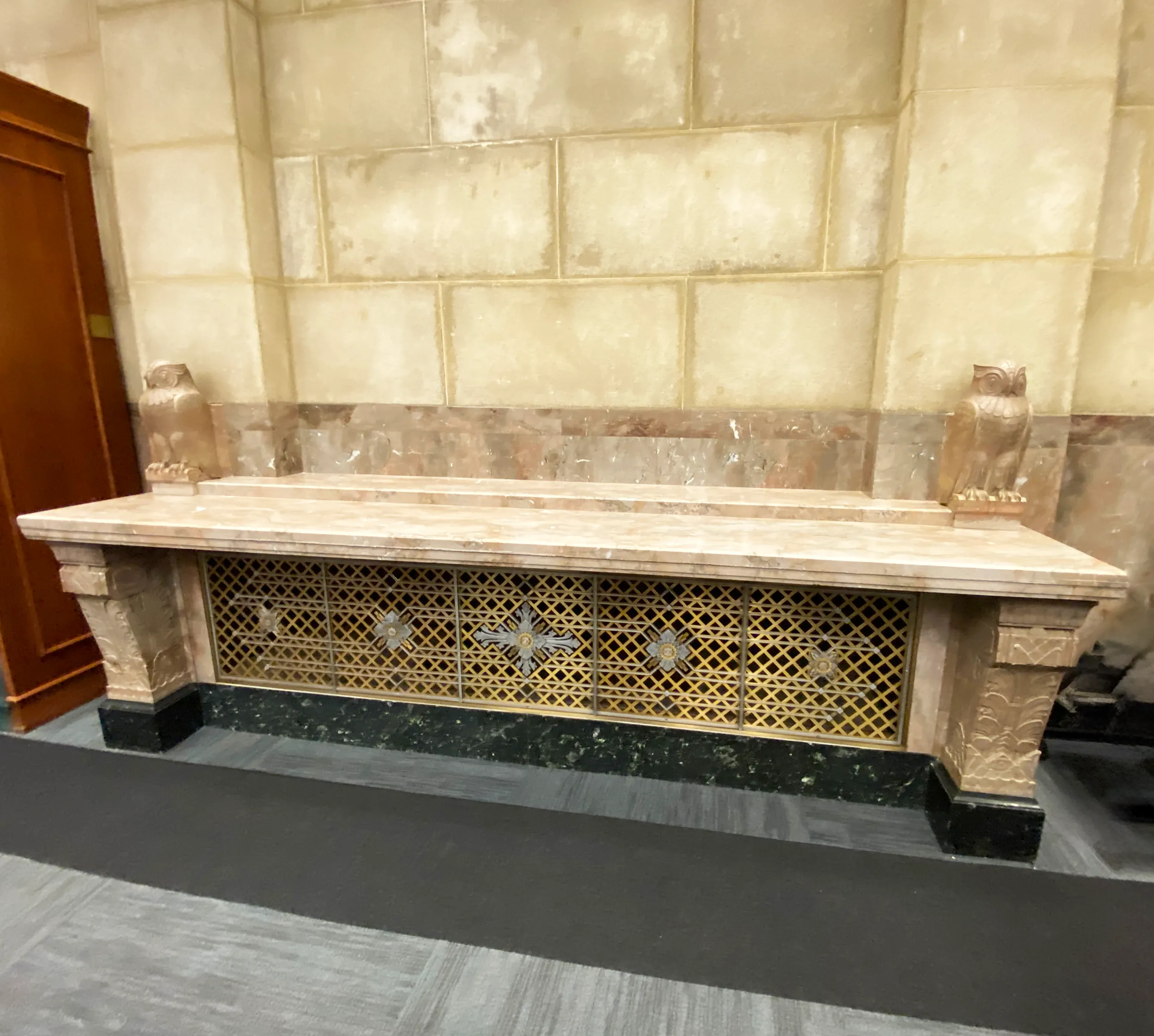
The building’s white marble exterior, owl motifs, metalwork, and sculpted doors establish a distinct identity before a visitor reaches the reading rooms. The Library of Congress notes that Lawrie designed the building’s bronze doors, whose high-relief figures refer to the history of the written word. That subject belongs exactly where it appears: at the threshold of a national library.
Look at the doors as more than decoration. A door has to be crossed, opened, and seen at close range. Its figures and symbols therefore have a different job from a tower or a facade relief. They turn a moment of entry into a small encounter with writing, learning, invention, and communication. The Library of Congress account of the John Adams Building connects those doors directly to Lawrie’s work at Rockefeller Center, making clear how one sculptor could adapt an architectural language to very different institutions.
Explore the archive’s John Adams Building record with this contrast in mind. A photograph of an owl or door becomes more meaningful when it is read as one part of a larger building made to honor knowledge and public access.
Use a four-step way of looking
A reliable visit does not require an expert vocabulary.
Read More
- Stand back. Notice the silhouette, strongest lines, and where the building directs your eye from a distance.
- Find the threshold. Study the entrance, its materials, lettering, figures, and the path that leads toward it.
- Change your distance. Compare the broad facade with a relief, door, grille, or ornament at arm’s length.
- Connect subject to purpose. Ask how the building’s symbols relate to learning, law, citizenship, work, or the people who use the place.
This method prevents two common mistakes. The first is calling every geometric pattern Art Deco without looking at the building as a whole. The second is treating sculpture as a separate object with no relationship to the route a visitor takes. The most convincing landmarks make scale, material, architecture, and subject work together.
The archive is especially useful for this way of looking because it preserves Lawrie’s work across whole buildings as well as in individual details. Compare the guide to Art Deco buildings with the guide to architectural sculpture, then follow their ideas into the work records. The goal is not to memorize a style. It is to notice how a building speaks through the sequence of things you can actually see.
Why Lee Lawrie makes a useful guide
Lee Lawrie’s work helps make Art Deco landmarks legible because it moves from distant public symbols to intimate details without losing its relationship to architecture.
Read More
His commissions include civic buildings, libraries, memorials, churches, and commercial sites, so they offer more than one version of the style. At the Nebraska State Capitol, sculpture helps sustain a large civic programme. At Rockefeller Center, it gives entrances and public spaces a memorable symbolic charge. At the John Adams Building, it brings the history of writing to doors and ornament that visitors meet close up.
That range is the archive’s particular strength. Rather than offering a list of landmarks detached from their art, it lets readers move from a question about Art Deco into the records, photographs, and architectural settings that make the answer tangible. For a deeper study of one complete public commission, Prairie Deco follows Lawrie’s work at the Nebraska State Capitol in detail.
Art Deco becomes more rewarding when a visitor stops asking only whether a building looks stylish. The better question is what the building is trying to say, and how its shape, entrance, images, and materials make that message visible.
Do not reduce a landmark to a checklist
One sunburst or stepped roofline does not explain why a building matters.
Read More
A landmark earns attention because many decisions hold together over time. Its silhouette makes it easy to recognize. Its entrance makes the building approachable. Its materials and details continue the same visual idea at close range. When sculpture is present, it gives the architecture a subject, a human presence, or a memory that an outline alone cannot provide.
This is why a landmark is best experienced in motion. A photograph can preserve an exceptional view, but it cannot fully show the sequence from street to door to interior. Notice what the building gives you first, what it saves for a closer look, and what repeats as you move through it. That sequence can be as revealing in a modest library or courthouse as it is in a famous skyscraper.
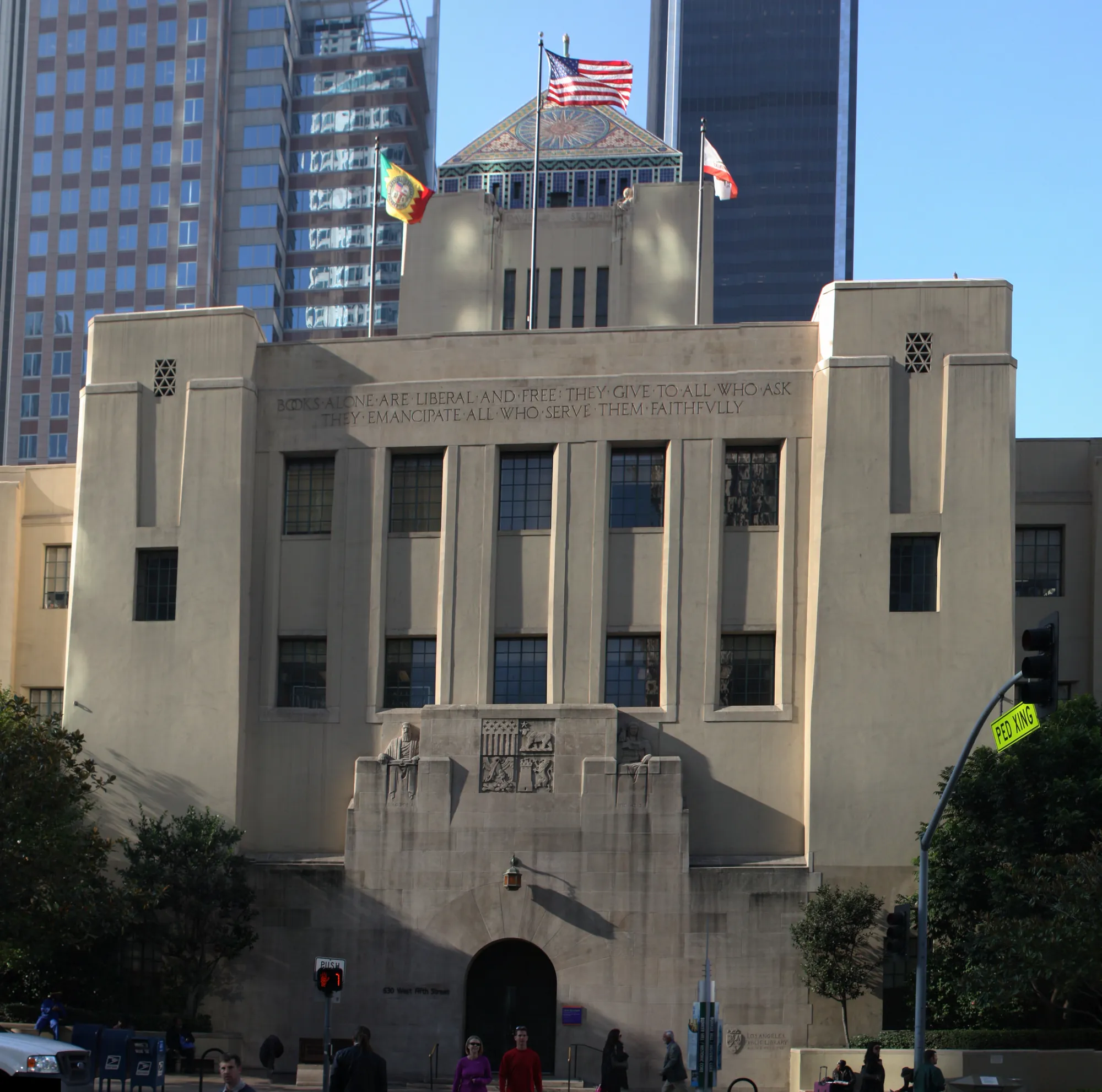
For readers ready to look beyond the landmark view, the archive’s Los Angeles Central Public Library collection offers another useful comparison. Its tower, entrance sculpture, and interior details show how an architectural programme can remain coherent while offering different discoveries at every distance.
Frequently asked questions
What makes a building an Art Deco landmark?
An Art Deco landmark usually combines a memorable overall form with deliberate detail at the entrance and throughout the building. Strong geometry, stepped or vertical massing, stylized ornament, rich materials, and sculpture connected to the building’s purpose are common clues.
What are some important Art Deco landmarks in the United States?
Rockefeller Center in New York, the Nebraska State Capitol in Lincoln, and the John Adams Building of the Library of Congress in Washington, D.C. each show a different public use of Art Deco. Their towers, entrances, sculpture, and interior details reward looking at more than one scale.
How should I look at an Art Deco landmark?
Start from across the street, then study the approach and entrance before moving close to the doors, reliefs, lettering, and interior details. This change of distance reveals how the building guides attention from its large shape to its smallest meaningful surfaces.
Why is sculpture important in Art Deco architecture?
Sculpture can make a building’s purpose visible. Figures, reliefs, doors, animals, and symbols can turn ideas about learning, law, citizenship, work, or technology into part of a visitor’s route through the building.
Related posts
 Art Deco
What Is Art Deco Sculpture? Definition, Features, and Examples
Art Deco sculpture uses simplified forms, strong geometry, and symbolic detail. See how figures, reliefs, doors, and ornament give a building its character.
Art DecoArt Deco Buildings: 5 Features to Look For
Learn the five features that make Art Deco buildings distinctive, from stepped skylines and grand entrances to materials, sculpture, and civic symbols.
 Art Deco
Famous Art Deco Artists: 6 Ways to See the Style
Meet famous Art Deco artists, including Tamara de Lempicka, A. M. Cassandre, Erté, René Lalique, and Lee Lawrie.
 Art Deco
Famous Art Deco Sculptors: 3 Artists and Their Work
Meet François Pompon, Waylande Gregory, and Lee Lawrie, then see how Art Deco sculptors used form, material, and setting to shape public places.