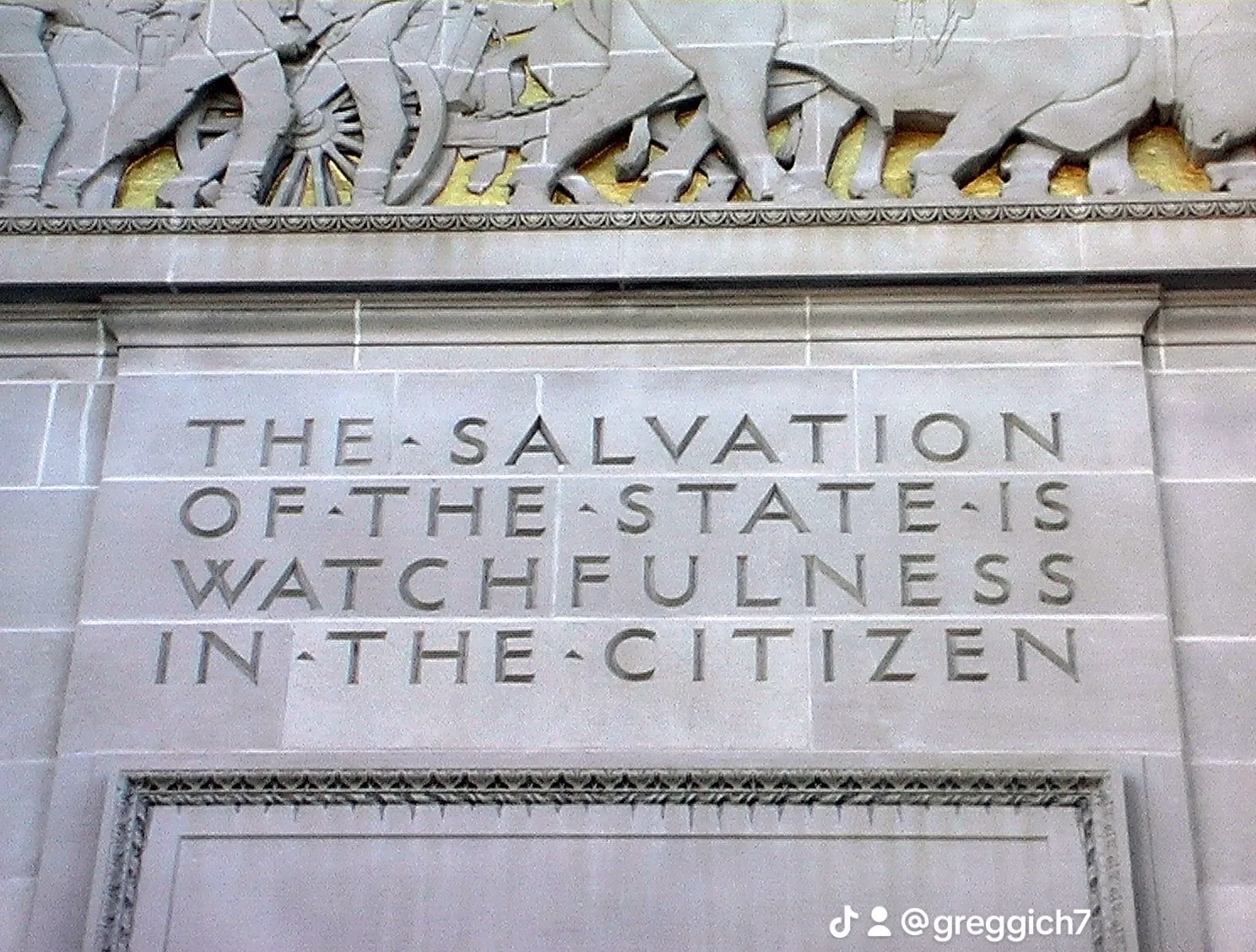
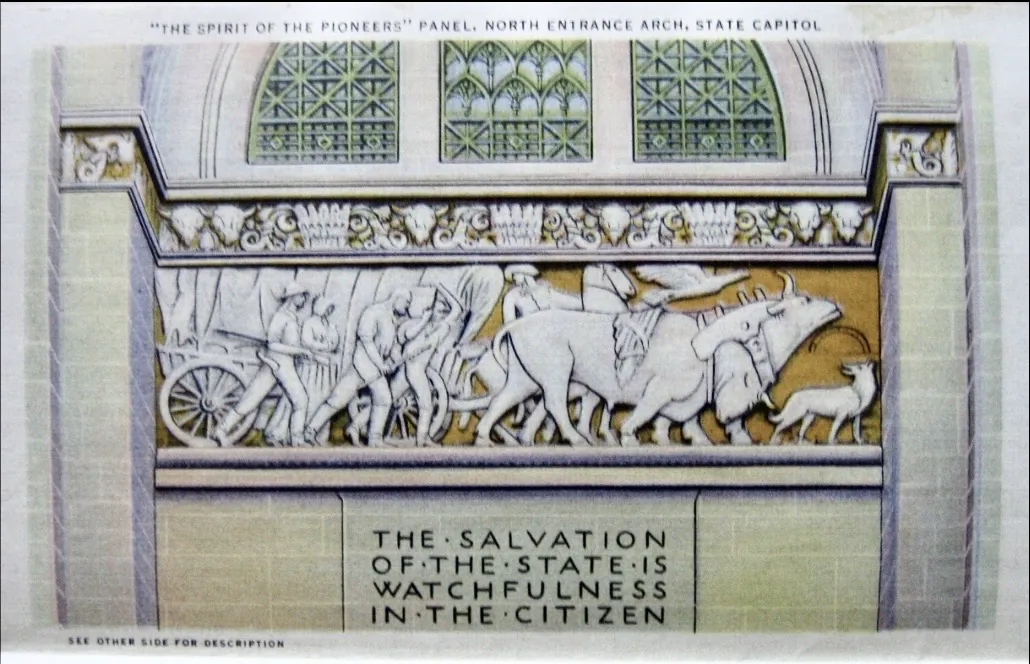
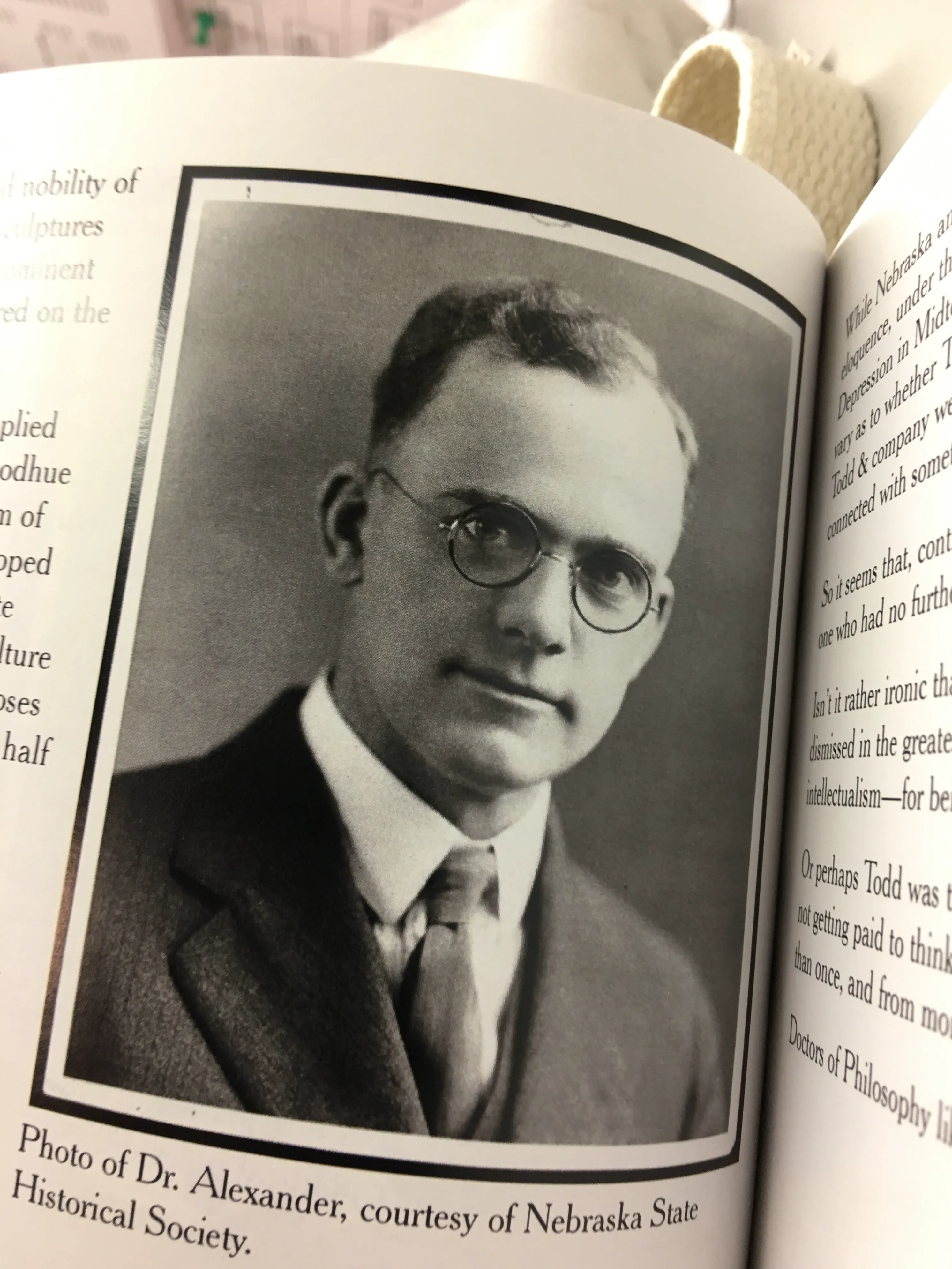
The words in the opening photograph appear above the main north entrance to the Nebraska State Capitol: “The Salvation of the State is Watchfulness in the Citizen.” They are Hartley Burr Alexander’s, and they condense the moral argument that runs through the building’s sculpture, mosaics and inscriptions. The portrait that follows introduces the thinker behind the statement.
Alexander was the son of George Sherman Alexander, a frontier minister, newspaper founder and tireless reader. Before settling in Syracuse, Nebraska, George ranged from Cape Cod to Salt Lake City as a horseback preacher, covering that extraordinary distance in the saddle. He later worked as a shopkeeper, insurance broker and minister, while building a personal library of books across many subjects. Hartley, first helping in the newspaper office as a printer’s devil, learned to set type before he learned how far that library would carry him.
Home life also made the library unavoidable. While helping his father prepare for evening prayer services, the young Alexander read widely, taught himself languages and built the habits of a scholar. He went on to study at the University of Nebraska, held fellowships at the University of Pennsylvania and Columbia University, and earned a doctorate from Columbia in 1901.
For several years, Alexander hoped to join Columbia’s faculty but did not secure a position there. He eventually made his way to Springfield, Massachusetts, where he worked as an editor for Merriam-Webster. When Webster’s Collegiate Dictionary appeared in 1909, Alexander was credited with editing every definition, from “bicycle” to “marriage.”
When the Capitol was being conceived in the early twentieth century, Alexander’s political outlook was Populist, a current that ran strongly through Nebraska as well. That conviction in civic participation and the common good helps explain why his Capitol programme gives such weight to citizens, public duty and the life of the state.
His route into architecture was not through a drafting room. Alexander came to the Capitol as a philosopher, historian of religion and student of Native American cultures. Bertram Goodhue asked him to develop the building’s thematic programme, and Alexander supplied the ideas that connected Lawrie’s sculpture, Hildreth Meière’s mosaics and the building’s inscriptions into a single civic statement.
The north portal makes that statement especially direct. Above the inscription, Lawrie’s Pioneer Panel recalls the hard journey of settlement. Below it, Alexander’s sentence shifts the meaning from memory to responsibility: a state is not saved by its stonework or its past alone, but by citizens who remain alert to their shared obligations.
That is why the inscription still matters. It is not a caption beside the Capitol’s art. It is one of the keys to reading the whole building, where the history of Nebraska, the work of government and the demands of citizenship are deliberately joined.